Which is the best geomembrane sheet?
Blog · 2026-06-12 · 0 views
1. Understanding the Hostile Environment of a TSF
Geomembranes deployed in tailings storage facilities face exceptionally arduous operational demands. They function within one of the harshest and most complex working environments across the entire civil engineering field. The entire geomembrane selection workflow must be premised on a comprehensive, in-depth grasp of these severe operational challenges:
Chemical Attack: The tailings slurry, a by-product of mineral processing, has extreme acid-base properties and contains unreacted mineral processing agents, toxic heavy metals such as lead, cadmium and mercury, and high concentrations of soluble salts and other harmful substances. Therefore, the anti-seepage lining of the tailings pond needs to have excellent chemical corrosion resistance to avoid degradation, cracking or structural damage caused by long-term exposure to slurry corrosive components, so as to maintain structural and functional integrity throughout the entire design life of the tailings pond.
Ultraviolet (UV) Exposure: During installation and before being covered, the geomembrane is exposed to intense solar radiation, which can degrade certain polymers.
Temperature Extremes: In extreme environments, from hot temperatures to frigid temperatures, materials undergo physical changes such as expansion and contraction. Therefore, the lining must have excellent flexibility and thermal stability to withstand repeated temperature cycles without embrittlement or strength loss.
Stress and Strain: Tailings ponds are complex structures that change dynamically. The uneven settlement of the foundation in the reservoir area, the long-term consolidation settlement of the natural foundation, and the ultra-high hydraulic pressure from the slurry tailings will cause the anti-seepage liner in the reservoir area to bear large, multi-directional complex stresses. Therefore, the anti-seepage liner must have an excellent tensile strength threshold and excellent puncture resistance.
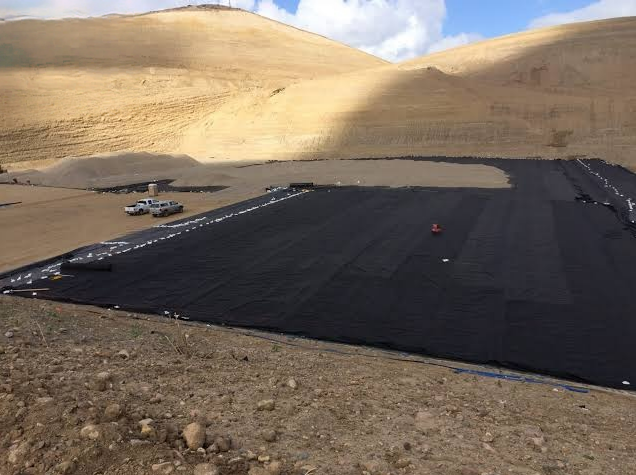
Installation Stresses: The sheer size of the TSF means the seams extend for kilometers. These seams are welded or bonded for quality assurance and are critical links to potential failures. 80 mil high-density polyethylene liner used in anti-seepage mining liner systems.
RONSINO Geosynthetics Best Geomembrane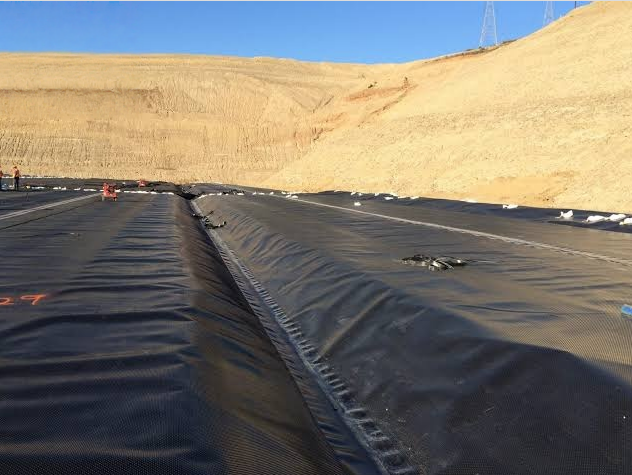
2. The Contenders: A Breakdown of Geomembrane Materials
There is no one type of geomembrane material that can deliver optimal performance across all possible usage scenarios. Selecting the most suitable product requires a comprehensive weighing and coordination of all the influencing factors mentioned earlier. The core geomembrane materials that are widely applied in tailings dam engineering projects mainly include the following categories:
2.1 Best Geomembrane – High-Density Polyethylene (HDPE)
Description: The undisputed workhorse of the mining industry. HDPE is a stiff, high-strength, durable polymer known for its exceptional chemical resistance.
Pros:
Superior Chemical Resistance: Highly inert, making it excellent for a wide range of aggressive leachates, including strong acids and alkalis.
High Tensile Strength: Excellent resistance to stress cracking under long-term load.
Proven Durability: With a long track record, its performance and lifespan (60+ years) are well-understood.
Cons:
Low Flexibility: More rigid than other options, making it less ideal for uneven subgrades or projects with potential for significant differential settlement.
Seaming Challenges: Requires expert fusion welding; seams can be brittle and are sensitive to poor workmanship.
Thermal Expansion: Has a high coefficient of thermal expansion, requiring careful design to manage wrinkles.
2.2 Best Geomembrane – Linear Low-Density Polyethylene (LLDPE)
Description: A more flexible and forgiving cousin of HDPE.
Pros:
Excellent Flexibility and Elongation: Conforms well to uneven subgrades and can accommodate more movement and settlement without damage.
Good Stress Crack Resistance: Superior to HDPE in many flexible formulations.
Easier Seaming: Softer nature can make field seaming slightly more forgiving.
Cons:
Lower Chemical Resistance: Generally less chemically resistant than HDPE, particularly to hydrocarbons and some organic solvents.
Lower Tensile Strength: Not as strong as HDPE, making it more susceptible to puncture under high loads.
2.3 Best Geomembrane – Polyvinyl Chloride (PVC)
Description: A very flexible material that is often reinforced with polyester scrim for added strength.
Pros:
High Flexibility: Extremely conformable and easy to install on complex shapes.
Ease of Seaming: Seams are made using solvent or adhesive systems, which can be simpler than thermal welding.
Cons:
Poor UV Resistance: Requires additives for UV stabilization and must be covered quickly.
Plasticizer Migration: The plasticizers that give PVC its flexibility can leach out over time, especially when exposed to certain chemicals, causing the material to become brittle and fail.
Generally not the first choice for primary containment in modern, high-risk tailing facilities due to long-term durability concerns.
2.4 Best Geomembrane – Reinforced Polypropylene (RPP)
Description: A strong contender that combines flexibility with high chemical and UV resistance.
Pros:
Excellent Chemical Resistance: On par with or exceeding HDPE for many chemicals.
Superior UV Stability: The most UV-resistant of the common geomembranes, ideal for extended exposed applications.
Flexibility: More flexible than HDPE while maintaining high tensile strength due to its reinforcement.
Cons:
Cost: Often more expensive than HDPE or LLDPE.
Seaming: Requires specialized dual-track thermal welding equipment.
3. Key Selection Criteria: Best Geomembrane Decision-Making Framework
Choosing the best geomembrane involves a systematic evaluation:
Compatibility Testing: This cannot be compromised. Candidate geomembranes must be placed in site-specific tailings leachate and laboratory tested in a high-temperature environment (e.g., ASTM D5747 standard method). This test is designed to evaluate changes in a material's performance in terms of weight, dimensional changes, tensile properties, and flexibility. The core objective is to screen out materials that exhibit minimal performance degradation when exposed to aggressive media over long periods of time.
Physical and Mechanical Properties:
Tensile Strength and Elongation: Does the project require the high strength of HDPE or the high elongation of LLDPE/RPP to handle deformation?
Puncture Resistance: What is the nature of the subgrade? A smooth geomembrane may require a protective geotextile if placed on a rocky subgrade.
Stress Crack Resistance: Critical for HDPE formulations. A notched constant tensile load (NCTL) test (ASTM D5397) should be specified to ensure long-term performance.
4. Site-Specific Conditions:
Subgrade Quality: A very uneven subgrade favors more flexible materials like LLDPE or RPP.
Climate: Projects in areas with high temperature swings must account for thermal expansion. High UV exposure sites favor HDPE or RPP.
Seismic Activity: In earthquake-prone zones, a geomembrane with high ductility and elongation-at-break (like LLDPE) is crucial to absorb seismic energy without rupturing.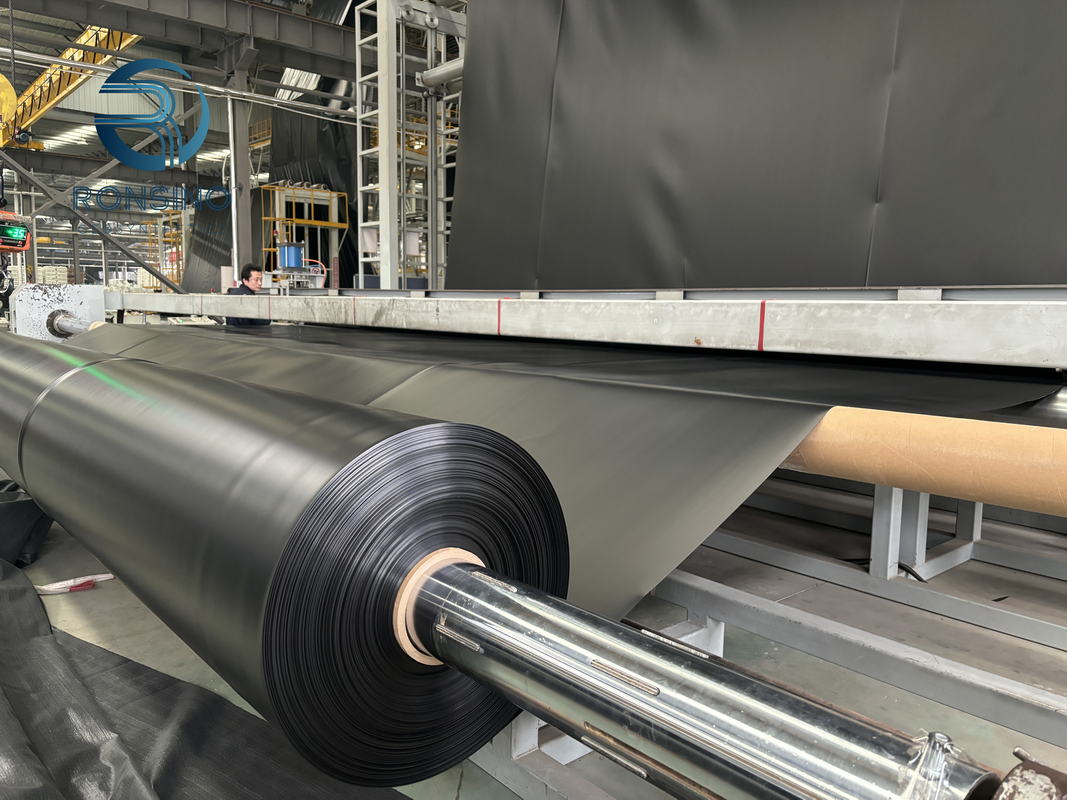
5. Installation and Quality Assurance (QA):
Even with the best materials, if not installed properly, the desired results will not be achieved. It is necessary to ensure that the selected materials are supported by an experienced professional team. For example, operators welding HDPE need to hold relevant professional qualifications.A strict quality assurance and control system needs to be established during the entire construction process, including daily destructive and non-destructive testing (such as peeling test, air pressure test) of all joints on site to ensure that each joint meets technical standards.
Best HDPE Geomembrane for Tailing Mines
Geomembrane HDPE 2mm for Mining Projects
6. Beyond the Material: The System Approach
A geomembrane is only one part of a composite liner system. It must be integrated with:
A low-permeability clay layer (compacted or GCL) to provide a secondary barrier.
Geonets or drainage composites to manage leakage detection and seepage.
Protective geotextiles to prevent puncture.
The interaction between all these components is critical to the system’s overall performance.
7.Conclusion
Selecting the appropriate geomembrane for a tailings pond is a multidisciplinary process involving geotechnical engineering, chemistry and materials science. There is no universal "best" solution, only the "most appropriate" choice under specific working conditions. High-density polyethylene is a commonly used material due to its corrosion resistance and high strength; linear low-density polyethylene is more flexible and suitable for complex foundations; and reinforced polypropylene can cope with harsh exposure environments. Decisions need to be based on material compatibility testing and comprehensive consideration of site conditions and environmental risks.
This decision is fundamentally rooted in the principle of accountability: ensuring finite underground mineral extraction does not cause irreversible ecological damage. When mining stakeholders choose evidence-based, rigorously researched solutions, they not only acquire functional materials, but also lay a solid foundation for long-term site operational safety, preservation of surrounding ecosystems, and the quality of life of future generations. The RONSINO geomembrane acts as an unobtrusive protector for tailings storage facilities; choosing it is a clear marker of forward-looking, responsible engineering practices that balance development and environmental stewardship.


