What is HDPE in Mining?
Blog · 2026-05-26 · 0 views

Mining industry act as an integral engine driving international commerce forward by delivering vital unprocessed components necessary for diverse manufacturing fields; yet simultaneously they produce extensive accumulations of debris labeled mine waste consisting primarily of pulverized remnants originating from metallurgical separation processes which are often infused with toxic reagents and elemental pollutants capable of inflicting substantial damage upon surrounding ecosystems or populace health whenever oversight measures prove insufficient Witnessing a series disastrous ruptures affecting Tailings Storage Facilities over past few years has emphasized pressing demand implementing cutting-edge trustworthy isolation technologies Standing out among modern countermeasures are High Density Polyethylene synthetic liners which distinguished themselves superior choice surfacing due unmatched synthesis featuring structural stamina tolerance against chemical exposure total leak via prevention capabilities Subsequent discussion thoroughly investigates technical specifications real-world scenarios deployment intricacies lasting rewards provided employing HDHE sealing systems overseeing effluent control thereby stressing irreplaceable contribution facilitating increased protection ethical standards green methodologies throughout exploration endeavors
1. The Imperative for Superior Containment: Beyond Traditional Methods
Throughout history strategies surrounding waste disposal have predominantly depended upon utilizing native earth substrates densely packed clays serve principal means confinement Although those materials present baseline capabilities impeding flow overall reliability exhibits marked variability largely because exposure harsh climatic elements Long term durability becomes threatened through distinct mechanisms such moisture loss causing fissure formation cyclical freezing subsequent thawing processes plus erosive reactions involving hazardous chemicals Furthermore despite possessing relatively reduced hydraulic conductivity values remain quantifiable thus permitting insidious fluid escape which precipitates prolonged subsurface water quality decline consequences now considered impermissible given current strict ecological regulations rising community demands sustainable industry practices
The fundamental objectives of a modern lining system in a TSF are multifold:
1.1 Absolute Containment
Establish an enduring and completely impermeable containment system designed to obstruct any seepage of tainted interstitial fluids industrial processing agents or minute particulate matter towards underlying geological formations consequently ensuring the preservation of aquifer integrity over an extended period
1.2 Enhanced Stability
The primary goal entails reinforcing mechanical resilience and overall safety via precise management of hydraulic saturation states within deposited mining residues; this strategic approach effectively minimizes susceptibility to soil fluidization events, which are widely recognized as a predominant causal factor behind catastrophic breaches at containment facilities.
1.3 Water Management
In order to ensure that fluids in the production process can be systematically recovered and reused, thereby greatly reducing the dependence of mine operations on primary freshwater resources and fundamentally establishing a zero-discharge water circulation mechanism, this has become an unshakable basic program for the implementation of an ecologically responsible mining model.
1.4 Facilitate Closure
To provide a reliable base for eventual closure and capping, turning a active facility into a stable, non-polluting landform.
RONSINO Custom HDPE Geomembrane
2.In-Depth: Key Properties of HDPE Geomembrane For Mining Tailings Applications
HDPE geomembranes are not simple plastic sheets; they are high-performance engineered materials. Their suitability for the harsh environment of tailings containment is rooted in a suite of meticulously designed properties:
2.1 HDPE Geomembrane For Mining – Exceptional Chemical Resistance
High-density polyethylene exhibits exceptional chemical stability allowing it to withstand an extensive range of corrosive substances such as potent acidic solutions alkaline compounds saline mixtures and oxidative elements which are frequently present within mine waste derived from diverse mineral resources like uranium deposits copper veins or gold seams Such robust resistance guarantees that both the physical framework and impermeable characteristics of the barrier system remain intact for many years which remains an indispensable requirement considering that sealed tailings storage facilities are engineered to function effectively for an indefinite duration
2.2 HDPE Geomembrane For Mining – Extremely Low Permeability
As an isolation barrier material, HDPE is almost completely non-permeable. Due to its dense and homogeneous polymeric structure, the material exhibits extremely low hydraulic conductivity values—typically below $10^{-13}$ meters/second—which allows it to successfully prevent convective migration of liquids and dissolved contaminants. Performance-wise, it far outperforms optimally compacted clay liner systems.
2.3 HDPE Geomembrane For Mining – Superior Mechanical Strength and Durability
High-density polyethylene geomembranes demonstrate superior mechanical performance characterized by exceptional tensile capabilities alongside robust resilience against tearing or puncturing forces such distinct attributes remain fundamentally vital both during the initial deployment phase where physical handling thermal seaming occur subsequently throughout extended service periods necessitating endurance of substantial loads imposed by accumulated mining waste possible uneven ground subsidence strain generated foundational support layers
2.4 HDPE Geomembrane For Mining – Enhanced UV Resistance
The top-grade high-density polyethylene (HDPE) anti-seepage geomembrane specifically combines a combination of approximately 2% to 3% high-purity carbon black and professional antioxidant additives in its manufacturing process. This carefully designed formula gives the product excellent UV resistance, which not only effectively curbs the occurrence of photo-oxidative degradation, but also ensures that the core mechanical strength and physical properties of the material remain intact, stable and reliable even after a long period of sunlight exposure before being buried in tailings stockpiles or overburden.
2.5 HDPE Geomembrane For Mining – Proven Seam Integrity
The necessity of establishing an unbroken, seamless membrane cannot be overstated. High-density polyethylene sheets are interconnected on-site through the utilization of advanced twin-belt thermoplastic welding apparatus. This technique elevates the adjoining surfaces to a liquefied condition and consolidates them under applied force, yielding a uniform joint that possesses nearly ninety to one hundred percent of the inherent strength of the base substrate. Each linear centimeter of these welds undergoes meticulous examination, ensuring the final deployed lining functions as a singular, highly efficient assembly.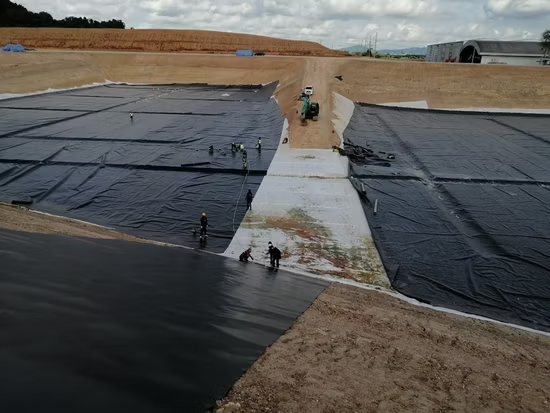
3.Application in Tailings Storage Facilities: The Composite Liner System
The industry best practice for tailings containment is rarely a single HDPE geomembrane. Instead, it is a meticulously engineered composite liner system where different geosynthetic and geotechnical components work in synergy to provide redundancy and enhanced performance. A typical robust system includes:
Prepared Subgrade:The foundation is paramount. The native soil is excavated, graded to precise design specifications, thoroughly compacted, and meticulously cleared of any sharp objects, rocks, or protrusions that could cause a localized puncture point.
Geotextile Protection Layer (optional): A cushion geotextile is often placed on the compacted subgrade. This non-woven fabric provides additional protection against puncture from subgrade irregularities and helps manage any subsoil gases.
The Primary HDPE Geomembrane Liner:This is the core hydraulic barrier. Installed in large panels by certified crews using specialized equipment, it is welded together to form a continuous sheet.
A Secondary Layer (Often a GCL):A geosynthetic clay liner (GCL)—a layer of bentonite clay bonded to geotextiles—is frequently placed either above or below the HDPE geomembrane. This creates a synergistic effect: the HDPE handles the primary fluid head, while the GCL provides additional chemical adsorption capacity and has self-healing properties for minor penetrations. In some designs, a compacted clay liner (CCL) is used as the secondary layer.
Leachate Collection Layer:A drainage layer of washed gravel or a prefabricated geocomposite drain network is placed above the liner system. This layer is critical for collecting any minor seepage (permeating through or around the liner) and promptly directing it to collection sumps. This allows for monitoring, treatment, or recirculation, ensuring no contaminated fluid builds up against the liner.
This multi-layered, composite approach is the gold standard, dramatically increasing the overall reliability, safety factor, and environmental performance of the TSF.
4.The Full Lifecycle: HDPE Geomembranes in Capping and Closure
High-density polyethylene geomembranes fulfill functions that go beyond merely confining liquid tailings during the initial storage phase. A pivotal stage in the lifecycle of a tailings storage facility (TSF) pertains to its eventual decommissioning and ecological restoration. The "dry closure" methodology, which incorporates the dewatering of tailings followed by the deployment of an engineered barrier system, is progressively becoming a regulatory prerequisite. This approach aims to establish a geochemically stable and structurally secure landform, thereby diminishing the necessity for extensive perpetual upkeep.
HDPE geomembranes are equally vital, if not more so, in these cover (capping) systems. They function as:
4.1 HDPE Geomembrane For Mining – An Ultimate Infiltration Barrier
The principal role of the geomembrane cover lies in obstructing rainfall from permeating the subjacent disposed tailings. This approach represents the most efficacious strategy to curtail the formation of supplementary polluted leachate and to inhibit or terminate acid mine drainage (ARD), a widespread complication associated with sulfidic tailings deposits.
4.2 HDPE Geomembrane For Mining – A Gas Migration Barrier
In cases where tailings may generate residual gases (e.g., methane, CO2), the geomembrane can act as a partial barrier to control surface emissions.
A conventional composite cap assembly typically comprises (ascending from the base): a permeable gas escape stratum, a safeguarding nonwoven fabric, the principal high-density polyethylene synthetic liner, a transmissive drainage mat, a growth medium stratum (earth substrate), and ultimately, indigenous plant life. This “retention-and-discharge” or containment cap configuration operates in harmony with the basal impermeable layer to perpetually segregate the residual mineral waste from the surrounding biosphere, facilitating ecological rehabilitation.
5.Addressing Challenges Through Rigorous Quality Assurance
The theoretical performance of an HDPE geomembrane system is entirely dependent on flawless execution in the field. Key challenges and their mitigation strategies include:
Seam Integrity: This is the most critical aspect. A single faulty weld can compromise the entire system. A rigorous Quality Assurance/Quality Control (QA/QC) program is non-negotiable. This involves:
Destructive Testing: Regular test strips are welded and sent to a lab for shear and peel testing to verify weld strength.
Non-Destructive Testing (NDT): 100% of all production welds are tested using methods like air pressure testing (for dual-track seams) or ultrasonic testing to identify any channels or flaws.
Subgrade Preparation: A perfect liner placed on a poor subgrade will fail. Meticulous subgrade preparation, inspection, and certification are essential steps that cannot be rushed.
Protection During Installation: The liner must be protected from damage during installation and subsequent phases of construction (e.g., placing drainage media). This requires careful planning, use of protective geotextiles, and low-ground-pressure machinery.
Therefore, success is guaranteed not just by the quality of the material, but by the expertise of the installation contractor and the oversight of experienced, independent geosynthetic engineers overseeing the QA/QC program.
HDPE Geomembrane 1.5mm for Tailings Ponds
Impermeable Geomembrane Liner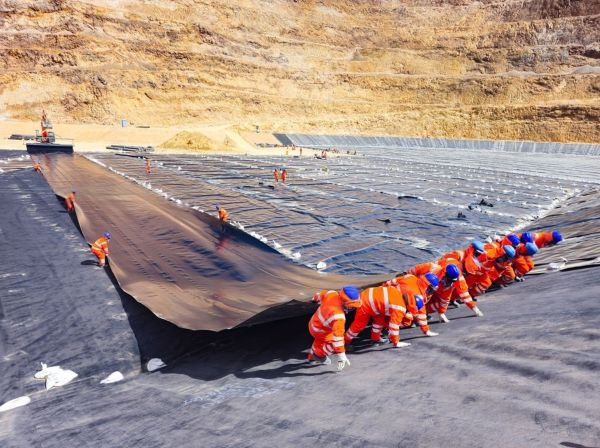
6.Conclusion: A Non-Negotiable Investment in Environmental Stewardship
Amidst an epoch marked by amplified ecological accountability, rigorous regulatory mandates, and heightened public oversight, the mineral extraction sector is compelled to unequivocally embrace state-of-the-art methodologies for managing tailings. The ramifications of inaction are simply unacceptable. High-density polyethylene geomembranes, especially when incorporated into a meticulously engineered composite barrier and closure assembly, stand as the most sophisticated, dependable, and empirically validated approach for the everlasting confinement of mining byproducts.
They establish an essential and resilient safeguard for our most vital assets: subterranean water reserves, land substrates, and ecological habitats. They fortify the structural integrity of waste containment systems, thereby shielding downstream populations and built environments. Moreover, by facilitating water reuse and promoting sustainable reclamation practices, they serve as a cornerstone for the implementation of circular economy principles within the mining sector.
The adoption of premium HDPE geomembrane solutions, supported by meticulous planning, superior production standards, and qualified implementation, transcends a mere financial outlay; it represents a critical commitment to minimizing risks, ensuring operational integrity, and maintaining the industry’s social acceptance. This approach is a clear embodiment of contemporary principles in ethical resource utilization, fostering a sustainable and beneficial heritage for posterity.
For comprehensive technical documentation, real-world applications, or professional guidance on deploying advanced HDPE geomembrane systems within your waste containment or site reclamation initiatives, feel free to reach out to RONSINO. Our specialized professionals are committed to enhancing operational safety and environmental stewardship across global mining endeavors through cutting-edge geosynthetic innovations.


