Plastic Geogrid Fabric for Road Construction in Guyana
Case · 2025-11-15 · 0 views
Benefit
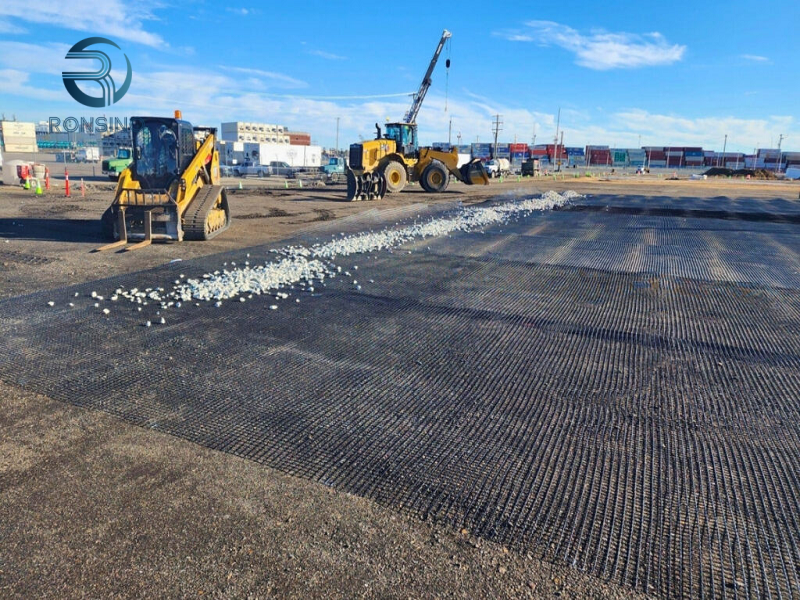
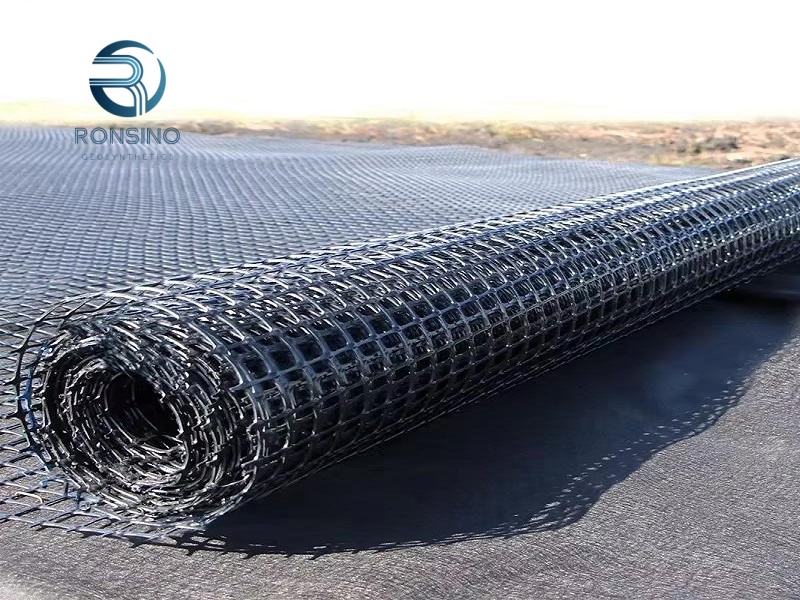
Polyester biaxial geogrid is applicable to the reinforcement of various dikes, embankments and subgrade, slope protection, tunnel wall reinforcement, permanent bearing foundation reinforcement of large airports, parking lots, docks and freight yards, etc.
Biaxial geogrid is used to increase the bearing capacity of subgrade and prolong the service life of subgrade.
Biaxial geogridis used to prevent the collapse or crack of the road (ground) surface and keep the ground beautiful and tidy.
Biaxial geogrid is used for convenient construction, saving time and labor, shortening the construction period and reducing the maintenance cost.
Biaxial geogrid is used to prevent cracks in culverts.
Biaxial geogrid is used to strengthen soil slope and prevent water and soil loss.
Biaxial geogrid is used to reduce the thickness of cushion and save cost.
Biaxial geogrid is used to support the stability and greening environment of grass planting mesh pad on the slope.
Polyester Biaxial Geogrid Features
Excellent mechanical properties and long-term stability.
High tensile strength.
High wear resistance.
Anti-corrosion resistance.
Balanced vertical and horizontal strength.
Strong tearing resistance.
Excellent soil surface adaptability, especially the tilted or curved surface.
High resistance to dynamic impact load and vibration activity.
Strong strengthening ability.
Excellent resistance to differential settlement.
Easy to install.
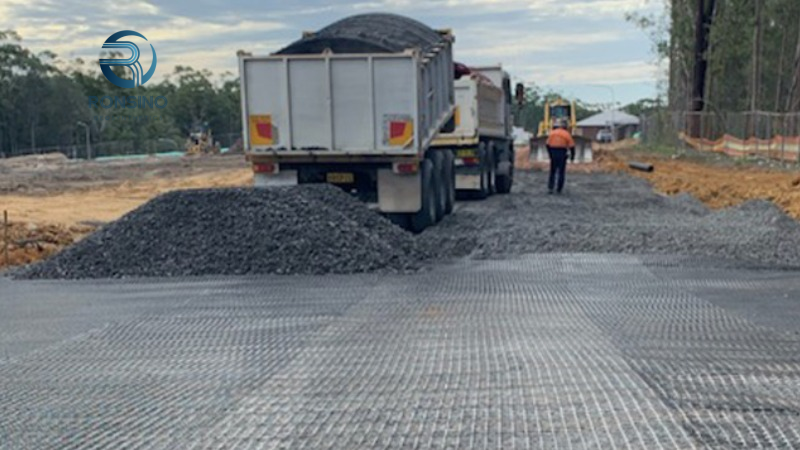
Issue
As operations extend and traffic volumes and axle loads increase, the structural integrity of old concrete pavements deteriorates significantly, making their rehabilitation a pressing challenge. The reconstruction of traditional slab pavement is time-consuming and labor-intensive and prone to opposition from many parties. The asphalt pavement system has the advantages of excellent driving quality, low noise and less dust. Using asphalt overlay to improve the functional performance of old roads has become a feasible solution. However, reflective cracks in the asphalt layer are still the main technical obstacle. Therefore, the customer purchased bidirectional polyester geogrids for infrastructure projects.
Solution
To address this problem, RONSINO recommends laying a polyester two-way geogrid reinforcement layer on the existing cement concrete pavement, and then laying an asphalt concrete surface layer. This innovative process can effectively suppress the reflection of cracks in the base layer, reduce rut deformation, and significantly extend the life of the road surface. This bidirectional mesh has the characteristics of high strength, low elongation, creep resistance, good compatibility with asphalt mixture, stable physical and chemical properties, high temperature resistance, strong interlocking and high binding force. Its core function is to uniformly distribute axial loads, convert crack stress from vertical to horizontal distribution, while improving the overall strength of the asphalt mixture and optimizing the stress distribution of the pavement structure, thus delaying the reflection of base cracks on the asphalt pavement and significantly extending the service life of the pavement.
Construction Method of Biaxial Geogrid
Construction site: it is required to be compacted, flat and horizontal, and remove spikes and protrusions.
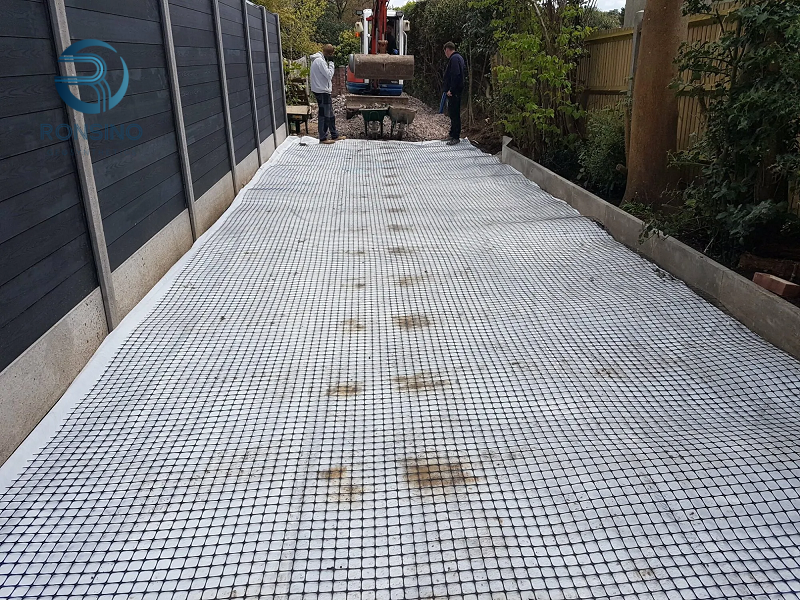
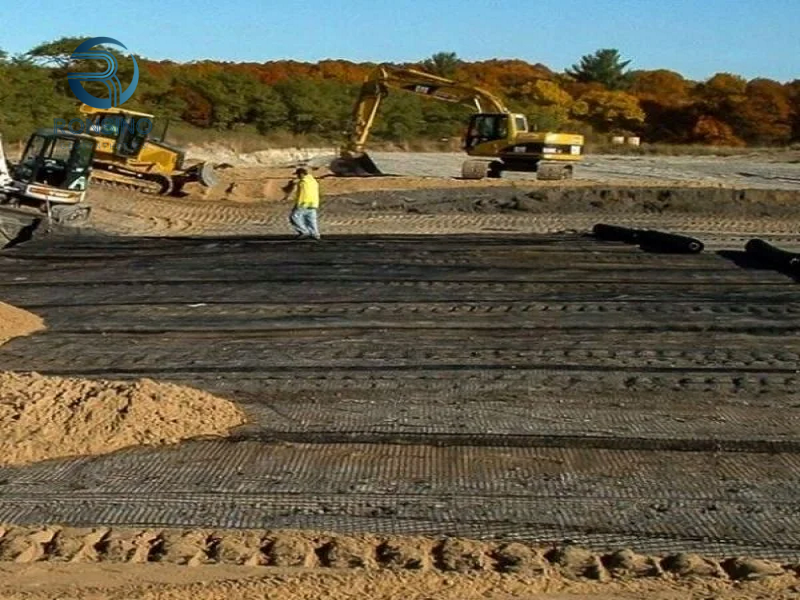
When laying the grating, it needs to be carried out on evenly compacted ground, and the main load-bearing direction (longitudinal) must be perpendicular to the central axis of the embankment. When laying geosynthetic materials, wrinkles should be eliminated and maximum tension should be maintained, and anchor piles and granular materials should be used to fix them. The laid grating must be continuous and uninterrupted throughout its length. Adjacent panels can be overlapped by manual binding, and the overlap width should not be less than 10 cm. When laying in multiple layers, the joints should be staggered. Large areas need to be leveled after laying. After the first layer of soil is laid and before compaction, the grid needs to be re-tensioned mechanically or manually to ensure that it is evenly stressed in the soil and remains straight.
Filler Selection: The filler must be chosen based on the specific design specifications. Empirical evidence demonstrates that most materials, excluding chalk soil and diatomaceous earth, are suitable as fillers. Nevertheless, gravelly and sandy soils exhibit superior mechanical stability and demonstrate minimal sensitivity to moisture variations, making them the optimal choice. The maximum allowable particle size for the filler is restricted to 15 centimeters, and careful attention must be paid to controlling the gradation of the filler to guarantee the required compaction density.
The geogrid should be backfilled immediately after laying, and the exposure time should not exceed 48 hours. Synchronized flow operations can be used to pave from both ends to the middle. The rolling must be carried out symmetrically from both sides to the center. It is strictly forbidden for the equipment to directly contact the grille. Vehicles are prohibited from passing through the non-rolling area to prevent displacement. The compaction thickness of each layer of filler is 20-30 cm, and the compaction degree must meet the design standards, which is the key to the success of the project.
In order to protect the foundation of the reinforced earth structure and reduce erosion, it is necessary to build a complete internal and external drainage system, using advanced filtering and drainage technology and materials such as geotextiles and fiberglass grids. This high-strength alkali-free glass fiber warp-knitted composite material has the characteristics of high strength, low elongation, high and low temperature stability, aging resistance and corrosion resistance. It is widely used in road reinforcement, roadbed stabilization, soft ground treatment and anti-cracking projects. It is suitable for asphalt cement pavement, railway embankment, coastal protection and other fields.
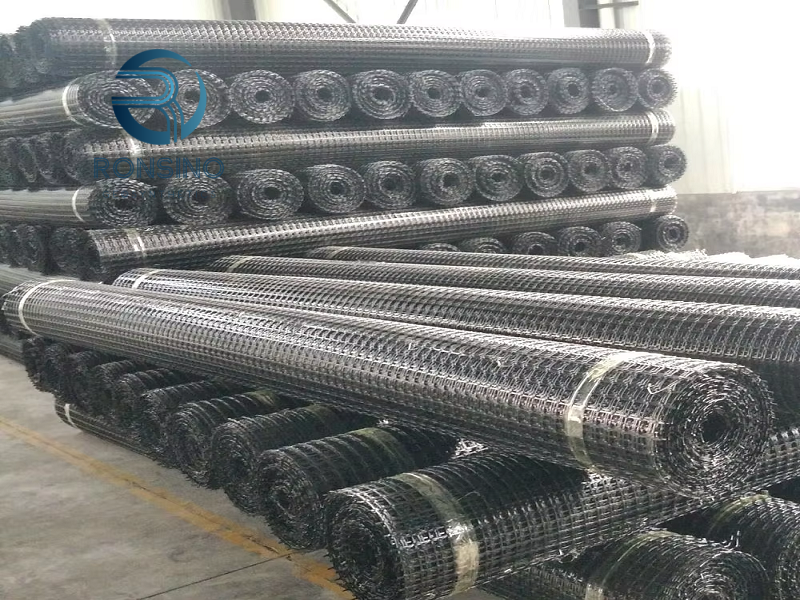
Case Study of Polyester Biaxial Geogrid for Road Construction in Guyana
Location : Guyana
Product(s) : Plastic Geogrid Fabric
Application : Road Construction
Properties– 15/15 kN/m
Specification – 3.95m×100m
Total quantity – 113760 square meters
Delivery time – 15 days
About RONSINO
RONSINO is committed to researching and developing and providing diversified high-performance geosynthetic materials to more than 36 countries around the world, covering geogrids, geomembranes, geotextiles and various new geotechnical products. Our core innovative high-quality geogrid products include plastic two-way tensile geogrids, fiberglass geogrids, plastic one-way tensile geogrids, warp-knitted polyester geogrids, and steel-plastic geogrid meshes. The high-quality geosynthetics of the RONSINO brand have passed many international authoritative certifications such as ISO9001, ISO14001, OHSAS18001, SONCAP, SASO, BV, SGS, and Intertek.
If you have any questions or inquiries, please fill in and submit the form to contact us.