Impermeable Pond Liner for Aquaculture Fish Pond Project in Comoros
case · 2025-12-31 · 0 views

Impermeable Pond Liner, commonly referred to as HDPE geomembrane reservoir liner or HDPE pond liner Comoros, demonstrates outstanding resistance to environmental stress cracking, remarkable durability in low-temperature conditions, exceptional resistance to aging, and robust corrosion resistance. Additionally, it performs reliably across a broad temperature spectrum and ensures an extended operational lifespan. This lining material also boasts a minimal permeability coefficient and superior water retention capabilities, effectively preventing pond water from seeping into the surrounding soil. It enables precise water level monitoring, significantly reduces water conservation expenses, and blocks the infiltration of harmful underground substances into the aquatic environment. By minimizing water contamination, it creates an optimal habitat for the healthy development of fish populations.
1.What Are Characteristics of HDPE Farm Pond Liner Material
1.1 High Impermeability
Impermeable Pond Liner surpasses conventional waterproofing solutions in terms of impermeability performance. HDPE impermeable membrane demonstrates superior tensile strength and mechanical resistance, while its exceptional elasticity and flexibility enable it to adapt to substrate expansion and contraction. This remarkable adaptability effectively addresses differential settlement issues in the foundation layer. Additionally, the material exhibits a high vapor transmission coefficient, ensuring optimal moisture management in aquatic environments.
1.2 Chemical stability
Impermeable Pond Liner have excellent chemical resistance and are a common choice for wastewater management, industrial containment and waste disposal sites. Its robust composition ensures excellent performance under conditions such as extreme temperatures and long-term exposure to hydrocarbons such as bitumen, petroleum derivatives and asphalt. It can resist strong acids, caustic solutions, salt environments and more than 80 corrosive chemicals.
1.3 Aging Resistance
Farm pond lining materials exhibit excellent anti-aging, anti-ultraviolet and anti-degradation properties and can be used directly exposed. The service life of the materials can reach 50 to 70 years, providing a solid material foundation for environmental anti-seepage projects.
1.4 Plant root resistance
Farm pond liner material has excellent puncture resistance, can resist most plant roots.
1.5 High mechanical strength
Farm pond liner material has good mechanical strength, fracture tensile strength 28MPa, fracture elongation rate 700%.
1.6 Low cost and high benefit
Advanced technology farm pond lining solutions improve anti-seepage performance. Its manufacturing process has been scientifically optimized to significantly shorten the production cycle. Therefore, this new liner is more economical than traditional waterproofing materials. Project evaluation shows that the use of high-density polyethylene (HDPE) anti-seepage membrane can usually save about 50% of the cost, which is significantly lower than the expenditure of traditional waterproofing systems.
1.7 Fast construction speed
Agricultural pond anti-seepage membrane materials have excellent flexibility, diverse specifications and sizes, and diverse laying methods to fully adapt to the anti-seepage needs of various engineering projects. This material uses hot-melt welding technology, the weld seam is extremely strong, and the construction process is convenient and efficient, which not only ensures the construction speed, but also ensures the health and safety of the project.
1.8 Environmental protection non-toxic
Pond lining materials are crafted from eco-friendly, non-toxic substances, ensuring safety for aquatic life and human use. Their impermeability relies on a straightforward physical barrier mechanism, preventing leakage without releasing any hazardous byproducts. These liners stand as the premier solution for sustainable aquaculture, eco-conscious water storage, and potable water reservoirs.
2. What Are Benifits of Impermeable Pond Liner Comoros for Aquaculture Fish Pond
The aquaculture industry in the Union of Comoros has experienced significant expansion over the past decade and has become the fastest growing segment of the fisheries sector. Statistics show that among the three major sub-sectors of the fishery, aquaculture has the highest annual growth rate, surpassing traditional artisanal fishing and large-scale commercial fishing. The industry's total aquatic production is generated primarily from a variety of farming practices, including freshwater and saltwater pond farming, freshwater and marine cage farming, and coastal farming activities.
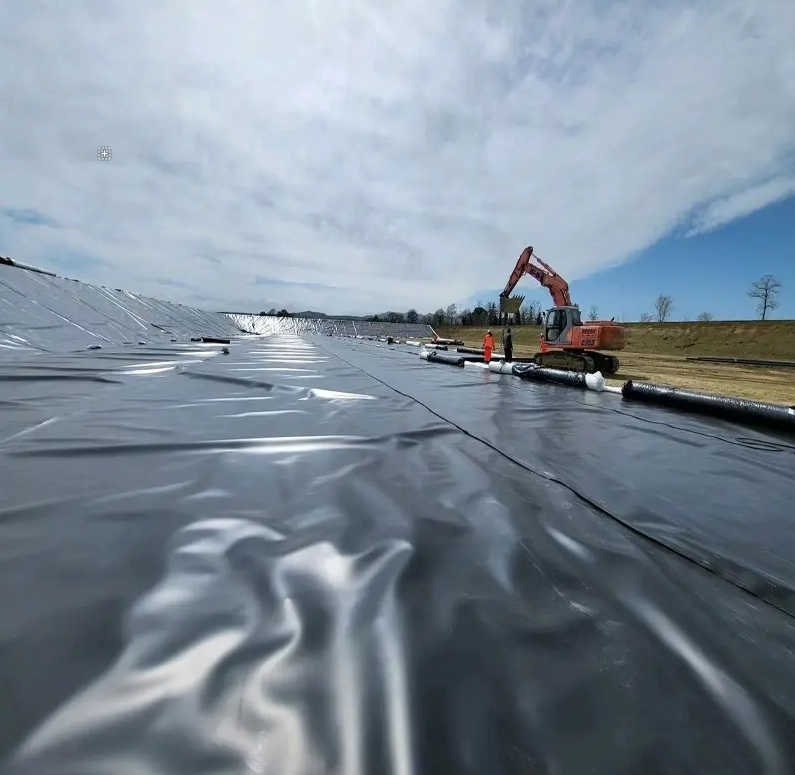
The client from Comoros plans to build fish ponds, mainly dedicated to carp farming. After browsing the successful aquaculture cases displayed on our website, they took the initiative to contact RONSINO's sales team to discuss in detail the project site conditions, the specific size of the fish pond, the recommended thickness of the required materials, and requested samples, technical parameters, installation guides and other information. We recommended the use of 0.75 mm thick geomembrane that complies with ASTM standards and immediately sent samples to the customer for testing. After receiving the sample, the customer quickly sent it to a third-party agency for testing, and the test results fully met their technical requirements. One month later, the customer officially placed an order for 60,000 square meters of geomembrane for the construction of the first project and successfully completed the installation project.
3.What Is The Service Life Expectancy of Fish Farm Pond Liner Material
Scientific investigations have revealed that a dense polyethylene sheeting measuring 0.75 millimeters in thickness, when enhanced with stabilizing agents, demonstrates a remarkable durability of six to seven decades when exposed to uncontaminated aquatic environments. Even when subjected to wastewater scenarios, this material maintains an operational lifespan spanning approximately sixty to seventy years. These substantial projections confirm that the geomembrane's extended longevity fully satisfies the impermeability standards essential for aquaculture infrastructure systems.
The anticipated longevity of aquaculture pond lining materials, including geomembranes, is primarily determined by their resistance to water penetration and moisture retention capabilities. Geomembranes represent a highly resilient synthetic product engineered to resist natural deterioration processes, ensuring structural integrity over extended periods. While post-utilization disposal or recycling may present logistical difficulties, their ecological footprint remains significantly limited throughout their operational lifespan.
Geomembrane provides a reliable and long-lasting solution for fish farm pond liners, ensuring effective seepage control and meeting the demands of aquaculture operations for an extended period.

4.Welding Methods of Impermeable Pond Liner
The welding process for Impermeable Pond Liner involves several important steps:
Adjusting Parameters: Begin by adjusting the pressure, temperature, and speed on the geomembrane welding machine. These settings are crucial for achieving proper weld quality.
Surface Preparation: Verify that the joints are entirely devoid of oil, dust, or any form of impurities. It is imperative that the overlapping sections of the HDPE geomembrane farm pond liner material remain free from sand or foreign particles. Should any debris be detected, it must be meticulously removed prior to welding to avoid any disruption during the welding procedure.
Daily test: At the beginning of each day, a sample strip with a size of 0.9 mm × 0.3 mm must be welded on site. The overlap width must be at least 10 cm. Peel and shear tests were performed on the sample strips using tensile equipment to comprehensively evaluate the firmness and integrity of the welded joints. After the sample passes the quality inspection, the calibrated welding rate, applied pressure and set temperature are recorded in detail. Clearly mark the date, time and ambient temperature on the surface of the sample for subsequent reference. During the entire welding process, the operating status of the thermal geomembrane welding machine needs to be closely monitored. Based on actual on-site operating experience and observations, the welding speed and temperature are finely adjusted to ensure the best welding quality.
Welds shall be regular and beautiful, and no sliding welding or jumping phenomenon shall be allowed.
When the geomembrane utilized in agricultural reservoir linings exhibits inadequate length, necessitating extended connections, the initial welding process should commence with transverse seams prior to addressing longitudinal ones. The transverse welds must maintain a separation exceeding fifty centimeters, forming a T-junction configuration to ensure structural integrity, with absolutely no overlapping or intersecting sections permitted.
The adjacent geomembrane farm pond liner material welding seam should be overlaps as far as possible. The junction formed between the film blocks should be T-shaped, and the cross type should be reduced as far as possible.
Welding film is not allowed to press out the dead fold, laying HDPE geomembrane, according to the local temperature change range and HDPE geomembrane function requirements, set aside the elastic deformation caused by temperature change.
When the temperature of the hand-held welder is lower than 200℃ as indicated by the temperature control of the hand-held welder, it is necessary to dust the welder with clean cloth or cotton yarn. If necessary, it should be repolished.
When the joints are affected by condensation, wetting and sediment, welding shall be carried out after treatment.
Welding cannot be carried out during the rain or in the case of moisture, dew, or sand at the seams, but the protective method is adopted outside.
When the temperature is lower than 5℃, no construction shall be performed according to the standard requirements. If necessary, the welding machine shall be preheated before welding.
Kneading welding machine in the welding process, should often check the gun head slider, wear more serious should be replaced in time to prevent damage to the film surface.
Geomembrane liner in welding should be used to stabilize the function of the generator power supply, in special cases to choose local electricity, it is necessary to use voltage regulator.
5.Specifications of Impermeable Pond Liner for Aquaculture Fish Pond Project in Comoros
Geomembrane HDPE – 0.75mm
Total Quantity – 60000 Square meters
Each roll Size – 7m*150m
Standard – ASTM standard
About RONSINO Geomembrane
Since its establishment in 2007, RONSINO has been committed to providing one-stop geosynthetic materials products and comprehensive solutions to global customers. The company has supplied a variety of efficient and technologically advanced geomembranes, geotextiles, geocells, bentonite waterproof blankets (GCL), drainage boards, geogrids and other products to more than 81 countries. Our core customer groups are located in Australia, France, Sweden, the United Kingdom, Hong Kong, Hungary, New Zealand, Poland, Mexico, Ecuador, Brazil, Pakistan, Bangladesh, Thailand, Vietnam, Malaysia, Indonesia, Singapore, Comoros, Sri Lanka, India, the United Arab Emirates, Saudi Arabia, Qatar, Kenya, Ghana, Ethiopia, Somalia, Nigeria, South Africa, Swaziland, Mongolia and other countries and regions.
RONSINO Geomembrane is not only manufacturing best quality geosynthetic products but also providing professional design and installation service. OEM, ODM, custom development and fabrication are also available. If you have any questions or inquiries, please contact us, we will reply as soon as possible.


