Impermeable Geomembrane Liner for Landfill Project in Tanzania
case · 2026-02-02 · 0 views

RONSINO Geomembrane offers high-performance, waterproof liners ideal for demanding applications like landfill containment. As a leading global supplier, we provide durable, leak-resistant solutions with customizable dimensions and thicknesses. Our cost-effective, bulk-purchase options feature competitive manufacturer pricing. Engineered for longevity, RONSINO's geomembranes meet rigorous quality standards for water containment, waste management, and environmental protection.
1. What Is Impermeable Geomembrane Liner for Sale?
1.1 Heavy-Duty Pond Liners: Materials and Key Features
Durable pond liners provide a strong waterproof layer for water features and commercial uses. The factory uses elastic materials such as synthetic rubber (EPDM), polyvinyl chloride (PVC) and high-density polyethylene (HDPE). Each has its own advantages: EPDM has excellent elasticity, PVC is cost-effective, and HDPE has a stable structure.These engineered polymers are tear, UV and hydrostatic pressure resistant and are suitable for use in decorative pools, landscape water features and engineered reservoirs to ensure long-lasting use. Advanced materials maintain performance in changing environments and prevent leaks in critical containment systems. Proper installation further enhances its effectiveness as a permanent liquid barrier.
1.2 Enhanced Performance for Landfill Applications
The improved landfill geomembrane has high mechanical strength and good chemical stability, and its double-layer structure enhances the soil-base bonding force. It is corrosion-resistant and wear-resistant, meets strict environmental standards, and its high-performance polymer material is suitable for extreme climates. Contains UV stabilizers and antioxidants, resists UV rays and oxidation, is dimensionally stable during installation, and has strong puncture resistance. The harmful substance blocking ability exceeds international standards and meets EPA requirements. Thermal expansion characteristics ensure stable joint strength, good long-term anti-seepage properties and low elongation. Standardized welding adapts to complex terrain. Environmental protection agencies have determined that it can effectively block leachate pollution, has extremely low permeability after long-term chemical exposure, is resistant to biochemical erosion, and has low maintenance costs.
1.3 Selection Guidance and Supplier Considerations
Selecting an appropriate industrial-grade liner involves careful consideration of key project parameters including liquid capacity, foundation stability, and potential weathering effects. Leading producers such as RONSINO provide specialized engineering consultations to align liner characteristics with operational requirements across various applications, from aesthetic ponds to essential barrier installations. Purchasers must validate product compliance certificates, examine completed project portfolios, and ensure vendor capabilities extend to supplying specialized joining tools or on-site implementation assistance for demanding installations.
2.What Are Benefits of Impermeable Geomembrane Liner for Sale for Landfill Project in Tanzania?
The use of heavy-duty pond liners for sale in landfill projects in Tanzania offers several benefits:
2.1 Reduction of Infiltration
Modern landfills use high-strength geomembranes as key liquid barriers, which can effectively reduce precipitation penetration and polluted runoff, and reduce treatment costs and ecological risks.The membrane can prevent leachate from contaminating groundwater and is a must-have configuration for ecological landfills. It can be used for more than 50 years after standard installation and contributes to sustainable waste treatment.Its multi-layer composite construction uses chemically resistant materials, such as high-density polyethylene, to resist waste degradation and stack pressure. Hot melt welding and strict quality inspection ensure that the system has no weak points.Engineering standards require strict testing of material thickness, puncture resistance and permeability. With intelligent monitoring and regular inspections, hidden dangers can be discovered and maintained in time to extend service life.
2.2 Odor and Gas Control
High-performance geomembrane barriers play a key ecological role in waste treatment facilities, effectively controlling atmospheric emissions and underground gases. The high-density polyethylene sealing layer seals the odorous materials within the garbage dump, significantly reducing olfactory disturbance to surrounding communities. The system works in conjunction with biogas collection facilities to direct the methane-rich gas to a centralized processing station, maximizing the use of landfill gas – either through combustion or conversion into sustainable electricity. Advanced landfills use breathable structures in composite liners that balance sealing and pressure regulation to meet stringent emissions standards while converting decomposition byproducts into valuable alternative energy.
2.3 Pathogenic Bacteria and Pest Control
High-quality pond liners can effectively eliminate vector breeding grounds in landfills, and their waterproof properties eliminate the formation of standing water, significantly reducing mosquito breeding.This technology completely isolates waste from surrounding soil and groundwater, blocking the transmission pathways of harmful microorganisms and significantly reducing the risk of contact between pathogens and surrounding communities.Practical applications show that community health indicators have been significantly improved after installation in high temperature and high humidity areas. Modern waste disposal systems have adopted it as a dual-effect solution that takes into account ecological protection and disease prevention and control.High-performance liner technology is an important advancement in sustainable waste management and can comprehensively prevent environmental pollution and public health risks caused by traditional landfill methods.
2.4 Prevention of Pollution and Spread
In environmental protection projects, geomembranes serve as key anti-seepage barriers, effectively preventing the leakage of pollutants and protecting the ecological balance of surrounding soil and water by building reliable waste management facilities. Its high sealing property achieves physical isolation between waste and the environment, which not only prevents wild animals from contacting harmful substances, but also limits the scope of human activities, greatly reducing the risk of poisoning. This technology is commonly used in modern waste treatment facilities to ensure operational safety and public health while meeting stringent environmental standards.
2.5 Soil Erosion Prevention
In modern landfills, geomembrane liners are key reinforcement materials. This high-performance barrier not only stabilizes underground rock formations, but also effectively resists precipitation and atmospheric erosion.Technicians laid it on the embankment to ensure structural stability during operation and in extreme weather. Its polymer matrix disperses soil loads and prevents deformation problems such as cracks or settlement.This protection solution can maintain the optimal landfill geometry for decades, significantly reducing maintenance requirements. Modern engineering combines the use of geomembranes with special geosynthetic materials to form a system with excellent slope reinforcement performance and extend the overall service life of the facility.
2.6 Landscaping and Reusability
Heavy-duty pond liners provide a strong, durable base layer to the surface for landscaping projects. This special material can also promote the development of plant roots, allowing the landfill to achieve ecological restoration and reuse of land resources after it reaches its useful life.
3.Why Choose Impermeable Geomembrane Liner for Landfill Project in Tanzania
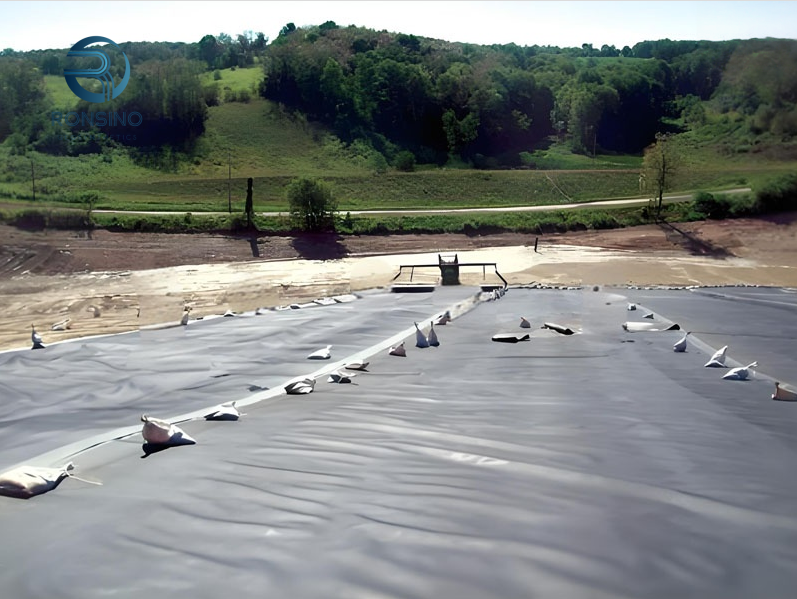
Selecting a robust geosynthetic liner for purchase to support a Tanzanian landfill initiative represents a prudent choice. Following a comprehensive assessment of various parameters, RONSINO advocates for the adoption of the advanced 1.5-millimeter geomembrane and extends a highly attractive pricing proposal to the client. To substantiate this suggestion, we present RONSINO’s corporate credentials, independent laboratory certifications, and documented accounts of extensive landfill implementations successfully executed in the past. This underscores our profound proficiency, unwavering dependability, and dedication to supplying premium geomembranes engineered for demanding landfill scenarios. Opting for our high-performance containment systems enables clients to fulfill regulatory obligations, achieve economic efficiency, and guarantee the triumphant realization of their waste management endeavors, all while upholding a strong commitment to ecological preservation.
4.Solution of Impermeable Geomembrane Liner for Sale for Landfill Project in Tanzania
The decommissioning of a waste disposal facility requires the installation of a multi-layered capping system composed of distinct functional strata. These strata, extending from the core of the waste mass to the final exterior grade, comprise the gas venting stratum, the leachate barrier stratum, the liquid conduit stratum, and the soil-growth medium stratum. Every individual stratum is engineered to fulfill a critical function, collectively guaranteeing the long-term integrity and performance of the closure. For a comprehensive capping system, the selection of the following strata is typically standard:
4.1 Exhaust Layer
The landfill cap design must integrate a venting layer to effectively regulate the gas pressure exerted upon the impermeable barrier. This component is constructed from coarse-grained, permeable media featuring particles that measure between 25 and 50 millimeters in diameter. It is required to exhibit a hydraulic conductivity exceeding 1×10⁻² centimeters per second and maintain a minimum depth of 30 centimeters. In lieu of this, a geocomposite drainage system possessing comparable fluid conveyance capabilities may be employed as an alternative gas extraction solution.
4.2 Anti-seepage Layer
The anti-seepage layer uses geosynthetic materials and consists of geomembrane and geotextile. The key layer should be made of high-density polyethylene (HDPE) or linear low-density polyethylene (LLDPE) geomembrane, with a thickness of not less than 0.75mm to ensure durability, and its permeability coefficient needs to be ≤1×10⁻⁷cm/s to maintain excellent anti-seepage performance. Geotextiles are laid on the upper and lower sides of the geomembrane to provide enhanced protection and structural reinforcement.
These chosen layers ensure the effectiveness of the landfill closure by preventing gas pressure buildup, minimizing seepage, and promoting proper drainage. It is crucial to adhere to these specifications to meet regulatory requirements and ensure long-term environmental protection during landfill closure operations.

5.Case of Impermeable Geomembrane Liner for sale in Tanzania Landfill Project
Total quantity– 40,000 squares meters
Geomembrane – 1.5mm
Each roll size is 5.8m*50m
6.About RONSINO Geomembrane
Since its establishment in 2007, RONSINO has been committed to providing one-stop geosynthetic materials products and comprehensive solutions to customers around the world. The company has supplied a variety of high-performance, cutting-edge technology geomembranes, geotextiles, geocells, geobentonite mats (GCL), drainage panels, geogrids and other products to more than 81 countries and regions.
RONSINO is not only manufacturing best quality geosynthetic products but also providing professional design and installation service. OEM, ODM, custom development and fabrication are also available. If you have any questions or inquiries, please contact us, we will reply as soon as possible.


