How Much Does Plastic Lining to Farm Ponds Cost
Blog · 2026-05-07 · 0 views

Agricultural reservoir anti-seepage membranes (also known as geomembranes or pond liners) are a key impermeable barrier technology that can transform depressions into reliable water storage facilities to support sustainable agricultural development. This material is mainly made of high-strength polymers such as HDPE, PVC, and EPDM. It can effectively prevent seepage, stabilize water levels, and prevent pollution. It is widely used in farmland irrigation, livestock drinking water, and aquaculture. It is predicted that the global geomembrane market valuation will increase from US$3.7 billion in 2026 to US$5.8 billion in 2035 at an average annual growth rate of 4.6%, highlighting its important role in water conservation. Research shows that anti-seepage membranes can achieve water savings of up to 85%. A 100,000-square-meter water tank can save farmers US$5,000 to US$20,000 per year and significantly increase crop yields.
The cost of agricultural pond liners is a key factor in financial planning for growers, construction professionals, and homeowners, with material prices ranging from $0.40 to $5.50 per square foot (approximately $4.31 to $59.20 per square meter), and installation costs adding 25–35% to the total cost ($0.25–$1.75 per square foot). Price differences stem from material composition, thickness, application range and performance standards, with HDPE accounting for 55% of the market share due to economics and a service life of 25–65 years (Geosynthetic Institute, 2023). Based on data from 2027 industry standards (Geosynthetic Institute, ASTM International and suppliers such as TAIAN RONSINO), this article systematically analyzes the cost structure, technical parameters and procurement methods. For a standard one-acre pond (43,560 square feet), the cost may be $18,000 to $165,000, but 25–40% can be reduced by purchasing HDPE wholesale, optimizing thickness, and foundation consolidation. This article will systematically review terminology, cost factors, material evaluation and selection criteria to provide evidence-based professional guidance for durable agricultural infrastructure.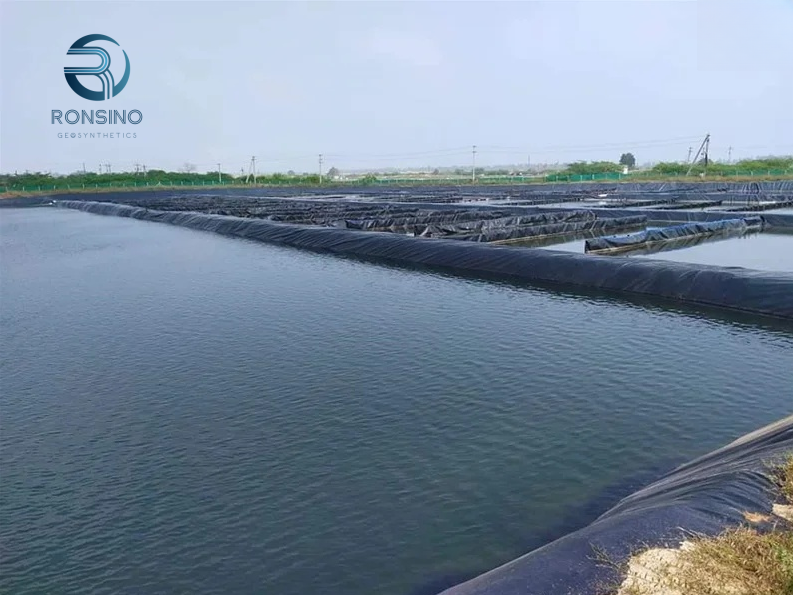
1. What Are Farm Pond Plastic Sheets?
Agricultural pond anti-seepage membrane (geomembrane liner) is a low-permeability synthetic engineering material used to isolate the aquifer and underlying soil, effectively preventing soil erosion and nutrient leakage. Its permeability coefficient is less than 10⁻¹⁷ cm/s, which is much better than traditional clay liners, and its long-term water retention rate reaches 95%–99%.The current product complies with GRI-GM13 and NSF/ANSI 61 standards. The surface embossing treatment makes the slope friction coefficient reach 0.8–1.2, improving stability by about 25%. The UV resistance is enhanced through the co-extrusion process, and the strength remains 90%–100% after 1,500 hours of exposure. The exposed service life can reach 10–20 years in arid areas.Practical applications show that this technology reduces the frequency of liner replacement by nearly 30%, improving the economy and sustainability of agricultural water storage systems.
1.1 Key Specifications of Farm Pond Plastic Sheets
The performance indicators of plastic fish pond anti-seepage membranes consist of a series of key parameters. These parameters have been strictly tested and certified by ASTM and ISO standards, and directly affect the market price and application scenario selection of the product. Core performance indicators mainly include the following aspects:
Thickness: Geomembrane thickness, measured in mils or millimeters (typically 20-80 mils or 0.5-2.0 mm), directly dictates its puncture resistance and longevity. Thinner membranes (20-30 mils) suffice for low-stress applications like shallow irrigation ponds. Conversely, demanding environments such as aquaculture, with frequent animal movement, require thicker liners (60-80 mils) to maintain structural integrity under constant pressure.
Tensile Strength: HDPE geomembranes show tensile strengths of 15-40 kN/m (ASTM D6693), outperforming PVC (15-25 kN/m) by 20-30%. Their higher strength (27-40 kN/m) suits applications needing 50-100 kPa pressure resistance at 1.5-3m depths.
Elongation at Break: 100–700% (ASTM D882), denoting adaptability to contours; EPDM’s 300–500% minimizes seam requirements by 15%, curbing installation vulnerabilities in undulating farm terrains.
Puncture Resistance: 200–800 N (ASTM D4833), indispensable against roots, rocks, or animal hooves; reinforced HDPE variants elevate this to 1,000–1,500 N, 40% superior to standard PVC.
Tear Resistance: 150–500 N (ASTM D1004), with scrim reinforcements amplifying 50% for erosion-prone sites.
UV and Oxidative Resistance: After 1,500 hours of xenon lamp exposure (per ASTM D4355 standard), the material maintained 90 to 100 percent integrity; adding carbon black stabilizers to high-density polyethylene (HDPE) can significantly extend its service life in agricultural environments to 15 to 20 years.
Chemical Resistance: >95% stability across pH 2–12 (ASTM D543), resisting fertilizers and pesticides common in farm runoff.
1.2 Applications of Farm Pond Plastic Sheets
The ubiquity of farm pond plastic sheets spans agricultural imperatives, with HDPE/LLDPE capturing 60% deployment for their equilibrium of affordability and resilience:
Irrigation Reservoirs: A 40% share of the market is allocated to high-density polyethylene (HDPE) geomembranes with a thickness range of 0.75–1.5 mm, compliant with GRI-GM13 standards. These membranes enhance water retention in arid regions, boosting irrigation efficiency by an estimated 20–30%. Additionally, they contribute to a measurable increase in agricultural yields—up to 15%, as projected by USDA research for the year 2026.
Livestock Watering Ponds: 25% usage; PVC (0.5–1.0 mm) for cost-sensitive troughs, NSF-61 certified to preclude biofouling, conserving $2,000–$8,000 in refills per 1-acre setup.
Aquaculture and Fish Farming: 20% share; EPDM (1.0 mm) upholds pH 6.5–8.5, elevating tilapia yields 15–20% via seepage blockade (Future Market Insights).
Erosion Control and Sediment Basins: Textured LLDPE (1.0–2.0 mm) for runoff capture; 95% sediment retention, aligning with NRCS guidelines and mitigating $3,000–$10,000 erosion damages.
Stormwater Management: HDPE for farm detention; EPA-compliant, attenuating flood peaks 40% in 2-year events.
TAIAN RONSINO New Material Co., Ltd (RONSINOGeosynthetics), leveraging 13+ years of extrusion prowess, furnishes these sheets for global farms, attaining 99% conformance via GRI/ASTM validations.
2. How Much Is The Farm Pond Plastic Sheet Price?
As of December 2026, the unit price of agricultural pond anti-seepage membranes is US$0.35 to US$5 per square foot (approximately US$3 to US$54 per square meter), and including construction services, it will rise to US$0 to US$6 (a 20-30% increase). HDPE (0.62-2 USD/square foot) accounts for 50% of the market due to its cost-effectiveness; PVC (0.35-1 USD) has a low purchase threshold; EPDM (0.75-2 USD/square foot) has good durability. Projects above 5,000 square meters can enjoy a 20-30% volume discount, and special membrane materials have a 10-15% premium. The current price has increased by 5%-8% year-on-year, mainly due to fluctuations in raw materials, but purchasing directly from Taian RONSINOcan save 15%-20% in costs. The key influencing factors will be analyzed below.
2.1 Farm Pond Plastic Sheet Price – Material Type
Material typology steers 40–60% of outlays, arbitrating upfront fiscal with protracted viability. 2026 delineations, per RONSINO and Future Market Insights:
High-Density Polyethylene (HDPE):The price of HDPE geomembrane is US$0.62-1.20/square foot, density 0.941-0.965g/cm³, tensile strength 27 kN/m, chemical stability >95% (pH 2-12), and life span 20-60 years. 0.5mm smooth surface $0.62-0.80, 1.5mm rough surface $1.00-1.20. The price of virgin materials (such as GRI-GM13 series) is +10%, and the defect rate is -20%. Agricultural irrigation is widely used. An investment of 27,000 to 52,000 US dollars is required for a 1-acre water storage tank. The water retention rate is 99% and the investment can be recovered in a short period of time.
Polyvinyl Chloride (PVC): The cost is US$0.35-1/square foot (3.77-10.76 yuan/square meter). The material is flexible (elongation 200%-400%) and easy to lay, but has poor UV resistance and a lifespan of 8-15 years. The unit price is US$0.35-0.5/square foot when the thickness is 20-30 mils. For small and medium-sized livestock ponds (25%), leachate management needs to be considered, and the annual maintenance cost is $0.05/square foot. Passing NSF-61 certification requires an additional 10% budget.
Ethylene Propylene Diene Monomer (EPDM): $0.75–$2.00/sq ft ($8.07–$21.53/m²). Elastomer (1.0–1.5 mm), with 300–500% ductility and UV endurance (30–50 years covered); puncture 1.5–7 kN. Favored in 20% aquaculture; 45 mil at $0.80–$1.50, heft (1.5 kg/m²) inflating freight 20%.
Alibaba 2026 aggregates affirm HDPE’s 35% fiscal primacy for >1-acre farms, EPDM’s 25% longevity bounty for fish-integrated systems.
2.2 Farm Pond Plastic Sheet Price – Thickness
Caliber, in mils/mm, linearly correlates with resilience, levying 10–20% escalations per gradation:
20–30 mil (0.5–0.75 mm): $0.35–$0.80/sq ft; apt for ancillary irrigation (10–20 years). Puncture 200–400 N; PVC/HDPE staple, e.g., 0.5 mm HDPE at $0.62.
30–45 mil (0.75–1.0 mm): $0.60–$1.20/sq ft; versatile aquaculture (20–40 years). Tensile 15–25 kN/m; EPDM 45 mil attains 640 N.
45–60 mil (1.0–1.5 mm): $1.00–$1.80/sq ft; robust livestock (30–50 years). HDPE textured reaches 1,000 N.
60–80 mil (1.5–2.0 mm): $1.50–$3.00/sq ft; industrial-grade farms (40–60 years). 30–40 kN/m, per ASTM D6693.
Augmented gauges amortize: 1.5 mm HDPE ($1.00–$1.20) vs. 0.5 mm ($0.62) yields $0.02–$0.04 annual over 40 years, incorporating 25% repair abatements (GSI).
2.3 Farm Pond Plastic Sheet Price – Project Size and Scale
Magnitude inversely modulates unit fiscal via volumetric efficiencies:
Small Ponds (<1,000 sq ft): $0.80–$2.50/sq ft; bespoke tailoring +5–10% (e.g., 500 sq ft trough: $400–$1,250).
Medium (1,000–10,000 sq ft): $0.50–$1.50/sq ft; 10–20% rebates.
Large (>43,560 sq ft, 1-acre): $0.35–$1.00/sq ft; 20–30% concessions ($15,000–$43,560 total). Geosincere’s MOQ 5,000 m² unlocks $0.10–$0.20 deductions.
Ampler scopes curtail seams (15% fewer via 50 ft rolls), per RONSINO, husbanding $0.05–$0.15/sq ft in adhesion.
2.4 Farm Pond Plastic Sheet Price – Installation Method and Labor
Deployment subsumes 20–30% ($0.20–$1.50/sq ft), varied by modality:
DIY: $0.20–$0.50/sq ft; viable for PVC/EPDM (tapes/adhesives), yet imperils 10–15% infiltrations absent expertise.
Professional: $0.50–$1.50/sq ft; HDPE extrusion ($1.00+) assures 99% junctures (ASTM D6392). Sloped locales (>3:1) +10–20%.
Underlayment: $0.15–$0.40/sq ft (200 gsm geotextile); thwarts 80% perforations.
Remuneration: $30–$120/hour agrarian vs. $15–$60 pastoral (Angi 2026); insular +15% conveyance.
2.5 Farm Pond Plastic Sheet Price – Raw Material Quality
Caliber—pristine vs. reprocessed—oscillates 10–20%:
Virgin Resin: $0.05–$0.15/sq ft surcharge; 95% probity (Geosincere’s HDPE) prolongs 20%, allaying $2,000–$10,000 rectifications.
Recycled: 10–15% abatement, yet 20% accelerated decay (GSI 2023).
Adjuncts: UV/antioxidants +$0.05/sq ft, amplifying resistance 90%.
ISO-vetted pristine, as Geosincere’s, forestalls $3,000–$15,000 in agrarian downtime.
2.6 Farm Pond Plastic Sheet Price – Transportation and Logistics
Carriage: $0.05–$0.10/sq ft national; 20% uplift for EPDM mass. Roll spans (4–8 m) abate seams, economizing 15% deployment. Geosincere’s Shandong nexus trims transoceanic 15–20% via compacted bundling.
2.7 Farm Pond Plastic Sheet Price – Maintenance and Lifetime Costs
Yearly stewardship: $0.01–$0.05/sq ft (scrutinies/mends). HDPE’s frugality (20–30% thrift over PVC) nets $0.03/sq ft quinquennial vs. PVC’s $0.05 (10 years). Aggregate possession: HDPE 35% thriftier protracted (Geosynthetic Institute).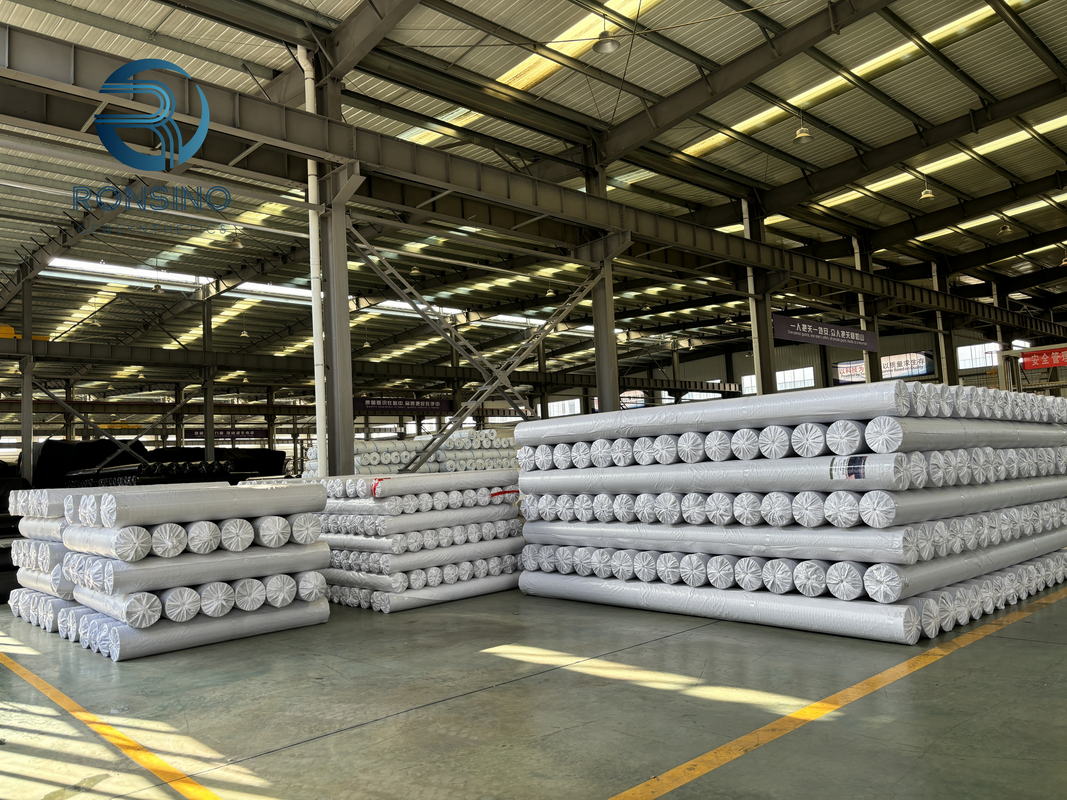
3. HDPE vs PVC vs EPDM: Detailed Comparison
Arbitrating among HDPE, PVC, and EPDM pivots on compromises in fiscal, metrics, and agrarian niche. HDPE predominates scalability/durability (50% quota), PVC thrift (25%), EPDM tenacity (20%).
3.1 HDPE Farm Pond Plastic Sheets: Specs, Pros, Cons, and Pricing
Key Specifications:
Thickness: 0.5–2.0 mm (20–80 mil)
Tensile Strength: 27 kN/m (ASTM D6693)
Elongation: 100–500%
Puncture Resistance: 640–1,500 N
Lifespan: 20–60 years
Permeability: <10⁻¹⁷ cm/s
Pros:
Economical ($0.62–$1.20/sq ft); volume 20–30% off
UV/chemical hardy (95% retention)
Fusible junctures (99% soundness)
Cons:
Rigid; adept deployment requisite (+10% toil)
Lesser pliancy for undulations
Pricing: 0.5 mm $0.62–$0.80; 1.5 mm $1.00–$1.20. Geosincere’s agrarian HDPE befits reservoirs.
3.2 PVC Farm Pond Plastic Sheets: Specs, Pros, Cons, and Pricing
Key Specifications:
Thickness: 0.5–1.5 mm (20–60 mil)
Tensile Strength: 15–25 kN/m
Elongation: 200–400%
Puncture Resistance: 200–500 N
Lifespan: 8–15 years (enshrouded)
Permeability: <10⁻¹⁰ cm/s
Pros:
Accessible ($0.35–$1.00/sq ft); novice-amenable
Pliant for diminutive ponds
Featherweight (0.5–1 kg/m²)
3.3 EPDM Farm Pond Plastic Sheets: Specs, Pros, Cons, and Pricing
Key Specifications:
Thickness: 0.75–1.5 mm (30–60 mil)
Tensile Strength: 10–20 kN/m
Elongation: 300–500%
Puncture Resistance: 1.5–7 kN
Lifespan: 30–50+ years
Permeability: <10⁻¹² cm/s
Pros:
Supremely ductile; radicle/UV stalwart
Ichthyic/flora innocuous (NSF-61)
Simplicious junctures (cohesives)
4. How to Choose the Right Farm Pond Plastic Sheet
Judicious election mitigates 15–25% surcharges.
4.1 Assess Project Requirements
Gauge magnitude (modest: PVC; vast: HDPE), utility (piscatorial: EPDM), and locale (inclines: ductile EPDM).
4.2 Prioritize Quality and Certifications
Espouse GRI-GM13/NSF-61; Geosincere’s 99% adherence forefends lapses.
4.3 Evaluate Installation Needs
Novice for PVC ($0.20/sq ft); adept for HDPE. Underlayment imperative (+$0.15–$0.40).
5. Industry Trends Affecting Farm Pond Plastic Sheet Prices
2026 vectors reconfigure agrarian fiscalities:
Resin Oscillations: Petroleum ascents (10–15% YoY) elevate HDPE/PVC 5–10%; reprocessed abates 10–15% (Research and Markets).
Sustainability Ascendancy: Bio-derivations/EPDM procure EPA rebates (15–20%); GRS-attested 25% quota.
6. Conclusion
In 2026, the cost of anti-seepage lining material for agricultural ponds is US$0.35-5/㎡, and after installation it is US$0.55-6/㎡. Mainstream materials: HDPE (0.62-1 USD/㎡) is economical and durable, PVC (0.35-1 USD/㎡) is flexible and impermeable, and EPDM (0.75-2 USD/㎡) has a long life. The tensile strength of the three is 15-40kN/m, the service life is 20-60 years, and HDPE accounts for 50% of the market share. The price is affected by material grade (high-quality products are 10-20% more expensive), scale (large quantities enjoy 20-30% discount) and labor cost (0.20-1 USD/㎡). Selected materials can increase returns, such as RONSINOpadding materials, which can have a return rate of up to 40%.For meticulous appraisements, TAIAN RONSINO New Material Co., Ltd (RONSINOGeosynthetics)—ISO 9001:2015 venerated, 36,000 m² atelier—dispenses paramount sheets. Convene +86 178 6266 7669 or sales@geosyntheticscn.com for prototypes and counsel. Procure sagaciously; your agrarian flourishes.


