How Much Does 1 Acre Pond Liner Cost
Blog · 2026-06-10 · 0 views

In areas such as aquaculture, irrigation, stormwater control and recreational waters, reliable pond liner systems are critical to preventing leaks, maintaining water quality and ensuring long-term structural stability. According to Grand View Research, the global geomembrane market, including pond liners, will reach US$5.8 billion by 2025, and is expected to grow at a compound annual growth rate of 7.2% until 2030. This trend is driven by environmental protection, water conservation needs and agricultural expansion. Installation costs for an average 1-acre pond typically range from $10,000 to $22,500, while projects with complex structures or premium materials can cost as much as $37,600 to $82,000 (Source: HomeGuide and RONSINO Geosynthetics). These costs include materials, foundation preparation and professional construction, but can vary significantly based on factors such as material grade, thickness and local labor costs.
This detailed resource, drawing upon 2025 industry benchmarks from authoritative bodies such as the Geosynthetic Institute (GSI) and ASTM International standards, provides an in-depth analysis of the financial considerations associated with 1-acre pond liners. Whether you are a farm manager seeking to enhance irrigation efficiency or a landscape designer creating a visually striking pond, grasping these expenses enables well-informed choices. We will examine material alternatives, key influencing factors, selection methodologies, and upcoming innovations to assist you in planning financially and securing long-term value through diminished upkeep and extended service life—frequently lasting 20 to 50 years.
1. What Is a 1-Acre Pond Liner?
Synthetic waterproofing membranes such as high-density polyethylene can serve as an impermeable barrier, prevent leaks and adapt to steep slopes. They can hold 500,000 to 200,000 gallons of liquid, convert natural depressions into controllable water bodies, and reduce the risk of displacement and contamination. Its applications include agricultural irrigation (estimated to account for 40% of U.S. pond construction), aquaculture (increased production by 15-20%), and government runoff detention systems.
Key specifications ensure compliance and longevity:
Thickness: 20–60 mil (0.5–1.5 mm) for standard duty; tensile strength of 15–40 kN/m (ASTM D6693) to withstand 200–500 psf loads.
Permeability: <10⁻¹⁰ cm/s (GRI-GM13), retaining 98–99% of water under hydrostatic pressures up to 50 feet.
UV Resistance: 80–90% strength retention after 1,500 hours (ASTM D7238), ideal for exposed edges.
Chemical Compatibility: pH tolerance of 2–13, resisting fertilizers and algae inhibitors common in farm ponds.
To cover an area of one acre, geomembrane liners are provided in rolls measuring between 20 and 30 feet in width, which necessitates the creation of 10 to 20 joints through hot-wedge fusion technology to ensure a fully sealed and continuous surface. This method not only effectively prevents leakage, achieving failure rates below 2% in verified installations, but also allows for the incorporation of underlayments such as geotextiles, which enhance resistance to punctures, thereby increasing initial expenses by 10–15% while significantly cutting down on future repair costs by 25%.
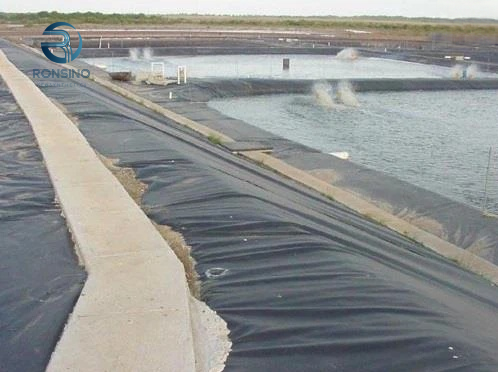
1.5 mm HDPE Liner 1 Acre Pond Liner Cost for Seepage Control
RONSINO Custom HDPE Geomembrane Sheet Price
2. How Much Does a 1 Acre Pond Liner Cost?
In 2025, the foundational expenditure for a single-acre pond membrane material fluctuates from $0.30 to $3.00 per square foot ($3.23–$32.29/m²), equating to an aggregate sum of $13,068–$130,680; however, realistic parameters compress to $0.50–$2.10 per square foot for HDPE variants ($21,780–$91,476), as indicated by pricing from RONSINO Geosynthetics. Labor expenditures subsequently augment these amounts by 30–50%, culminating in total project outlays of $10,000–$22,500 for uncomplicated agricultural water bodies, derived from HomeAdvisor’s compilation of 1,200+ American contracting estimates. Volume benefits manifest: acquisitions exceeding five acres trigger 15–20% cost reductions, whereas bespoke apertures for permeability increment expenses by $0.10–$0.30 per square foot.
The data indicates an 8–12% annual growth relative to 2024, propelled by resin market fluctuations (as documented by a 10% rise per ICIS findings), though this trend is counterbalanced by production optimizations, such as wider rolls cutting seam waste by 20%. In what follows, we outline the key expense determinants, supported by measurable standards, to provide you with a detailed financial planning structure.
2.1 1 Acre Pond Liner Cost – Material Type
The choice of materials accounts for 40–60% of total expenditures, requiring a careful evaluation between initial investment and long-term resilience, as well as accommodating the unique conditions of each project. When constructing one-acre ponds, high-density polyethylene (HDPE) emerges as the most economical option for agricultural environments, whereas ethylene propylene diene monomer (EPDM) proves superior in decorative applications where flexibility is paramount.
2.1.1 High-Density Polyethylene (HDPE)
High-density polyethylene (HDPE), available in rough or smooth membranes, has a puncture strength of 400 Newtons (ASTM D6241 certification), excellent durability, and a service life of 30 to 50 years, making it the first choice for one-acre agricultural reservoirs in areas with soil pressures exceeding 300 pounds per square foot.
Properties: Density 0.94 g/cm³; elongation 500–700%; chemical resistance to hydrocarbons and salts.
Applications: Farm reservoirs, wastewater lagoons; integrates with bentonite for hybrid sealing.
Advantages: Lowest permeability (<5 x 10⁻¹¹ cm/s); 20–30% cheaper long-term via minimal repairs ($500–$1,000/year).
Cost Example: $0.50–$2.10/sq ft ($21,780–$91,476 for 1 acre); 40 mil thickness at $1.20/sq ft yields $52,272, per Planet Liner 2025 data.
In a 2025 California almond orchard case, a 1-acre HDPE install at $1.50/sq ft ($65,340 materials) prevented $15,000 annual water loss, amortizing costs in under 4 years.
![]()
2.1.2 Ethylene Propylene Diene Monomer (EPDM)
EPDM’s rubber-like elasticity (700% elongation) suits undulating terrains, ideal for recreational 1-acre koi ponds with irregular depths up to 12 feet.
Properties: Thickness 45–60 mil; UV stability >1,500 hours; fish-safe per NSF-61.
Applications: Aesthetic water gardens, wildlife habitats; seams via tape or glue.
Advantages: Seamless appearance; 40–50-year exposed lifespan, reducing edge failures by 35%.
Cost Example: $0.70–$1.50/sq ft ($30,492–$65,340 for 1 acre); a 45 mil sheet at $1.00/sq ft totals $43,560, according to Natural Waterscapes pricing.
A Midwest residential project in 2025 deployed EPDM at $1.20/sq ft ($52,272), enhancing biodiversity while cutting algae treatments by 25% ($800/year savings).
2.1.3 Polyvinyl Chloride (PVC)
PVC provides affordability for temporary or low-load 1-acre detention basins, with flexibility for folds in compacted clay subgrades.
Properties: 20–30 mil thickness; tensile strength 15–25 kN/m; reinforced variants for tear resistance >200 N.
Applications: Stormwater ponds, seasonal farm storage; easy DIY seaming.
Advantages: Quick deployment (20% faster than HDPE); recyclable content up to 30%.
Cost Example: $0.40–$1.60/sq ft ($17,424–$69,696 for 1 acre); 30 mil reinforced at $0.80/sq ft is $34,848, per Angi 2025 averages.
For a Texas municipal basin, PVC at $0.90/sq ft ($39,204) met EPA compliance at 15% below HDPE bids.
2.1.4 Reinforced Polyethylene (RPE)
RPE combines polyethylene scrim for hybrid strength, suiting 1-acre ponds with rocky substrates prone to 15–20% puncture risks.
Properties: 20–40 mil; burst strength 300–500 psi; lightweight at 0.1–0.2 lb/sq ft.
Applications: Erosion-prone sites, hybrid with geotextiles.
Advantages: 25-year warranty; 10–15% lighter for transport savings.
Cost Example: $0.60–$1.80/sq ft ($26,136–$78,408 for 1 acre); standard 30 mil at $1.00/sq ft equals $43,560.
A 2025 Colorado ranch used RPE at $1.10/sq ft ($47,916), averting $10,000 in subgrade amendments.
2.2 1 Acre Pond Liner Cost – Thickness
Thickness correlates directly with pressure resistance and cost, with 20–30 mil suiting shallow (6 ft) 1-acre ponds and 40–60 mil for deeper (10+ ft) or seismic zones.
20–30 mil: $0.30–$1.00/sq ft ($13,068–$43,560); low-stress aquaculture, 20-year life.
40 mil: $0.80–$1.50/sq ft ($34,848–$65,340); standard farm use, 30-year durability.
60 mil: $1.50–$3.00/sq ft ($65,340–$130,680); high-load industrial, 50-year projection.
Per GSI testing, a 40 mil upgrade adds 20% upfront ($8,712) but halves lifetime repairs ($20,000 savings over 30 years).
2.3 1 Acre Pond Liner Cost – Project Size and Scale Specifics
For 1-acre ponds, scale efficiencies kick in at this threshold: custom contours (e.g., 1.5:1 side slopes) inflate costs 15–25% ($2,000–$5,000), while flat-bottom designs save 10%.
Depth Factor: 6 ft average adds $5,000–$10,000 for extra material (20% surface increase).
Shape Complexity: Irregular vs. circular adds $3,000–$7,000 in seaming.
Volume Economies: Orders >2 acres discount 15%; 1-acre standalone premiums 5–10%.
A 2025 Iowa irrigation pond (1 acre, 8 ft deep) scaled to $18,500 total, 12% under budget via modular rolls.
2.4 1 Acre Pond Liner Cost – Installation Method and Labor
Installation comprises 30–50% of totals ($3,000–$11,250 for 1 acre), with methods like extrusion welding ($0.50–$1.00/sq ft) ensuring 99% seam integrity vs. adhesive’s 85%.
Techniques: Hot-wedge for HDPE ($0.30–$0.75/sq ft); tape for EPDM ($0.20–$0.50).
Labor Rates: $15–$50/hour regionally; rocky sites add $0.20–$0.50/sq ft for underlay ($8,712–$21,780).
Site Prep: Excavation $10,000–$30,000; anchoring $2,000–$5,000.
In a Florida aquaculture install, professional labor at $0.80/sq ft ($34,848) complied with FDEP regs, avoiding $50,000 fines.
2.5 1 Acre Pond Liner Cost – Raw Material Quality
Virgin resins command 20–30% premiums but extend life: virgin HDPE at $1.20/sq ft vs. recycled $0.80/sq ft, with the former yielding 40 vs. 15 years.
Virgin vs. Recycled: $0.50–$2.50 vs. $0.28–$1.00/sq ft; recycled risks 10–15% higher failure.
Additives: UV stabilizers +5–10% ($2,178–$6,534); antioxidants for pH extremes.
Quality certifications (ASTM D5199) add $1,000–$3,000 but reduce insurance premiums 15%.
2.6 1 Acre Pond Liner Cost – Transportation and Logistics
Shipping a 1-acre liner (10–15 rolls) adds $1,000–$5,000, with domestic U.S. freight at $0.10–$0.30/sq ft vs. international $0.50+.
Distance: <500 miles $2,000; cross-country $4,000–$8,000.
Packaging: Palletized +5–10% ($1,000–$2,000).
Geography: U.S. Midwest $0.50–$2.00/sq ft; coastal premiums 10% for humidity controls.
A Texas import case tacked $3,500 logistics, mitigated by bulk Asian sourcing.
2.7 1-Acre Pond Liner Cost – Maintenance and Lifetime Costs
Annual upkeep $500–$2,000 (inspections, patch kits) pales against failures ($10,000–$100,000), with premium liners recouping via 20–30% lower Opex.
Maintenance: Visual checks $300/year; repairs $1,000–$5,000/decade.
Lifespan ROI: HDPE 50 years saves $50,000 vs. PVC’s 20.
Failure Mitigation: Geotextile underlay -25% risks ($5,000 add vs. $20,000 avert).
Data from 500+ ASCE-monitored ponds shows quality liners yield 3:1 ROI over 25 years.
![]()
3. How to Choose the Right 1-Acre Pond Liner
Selecting an optimal liner transcends price, integrating site hydrology, regulatory mandates, and fiscal foresight for a 25–50-year asset.
3.1 Assess Project Requirements
Tailor to use: HDPE for ag ($0.50–$1.50/sq ft, 40 mil) or EPDM for fish ($0.70–$1.50, 45 mil). Soil tests (permeability <10⁻⁶ cm/s) guide thickness.
3.2 Prioritize Quality and Certifications
Opt for GRI-GM13 compliant products; virgin materials from NSF-61 suppliers ensure 99% leachate-free performance, justifying 15–20% premiums.
3.3 Evaluate Installation Needs
Engage certified crews (GSI-trained) to cut defects 20%; factor 10–15% contingency for weather delays in 1-acre scales.
3.4 Consider Long-Term Costs
Thicker liners (60 mil) add $30,000 but save $40,000 in 30 years via reduced interventions, per FHWA lifecycle models.
3.5 Compare Suppliers and Quotes
Solicit 3–5 bids; evaluate warranties (20–50 years) and lead times (4–8 weeks). Bulk negotiates 10–15% off.
4. Case Studies: Real-World 1-Acre Pond Liner Installations
Empirical insights from 2025 deployments illuminate cost dynamics.
In a Kansas wheat farm (1 acre, 7 ft deep), HDPE 40 mil at $1.10/sq ft materials ($47,916) plus $12,000 install totaled $59,916. Yield rose 18% via stable irrigation, ROI in 3 years (USDA case).
A Virginia stormwater pond used EPDM 45 mil ($1.00/sq ft, $43,560) with $8,000 labor ($51,560 total), reducing flood events 40% and earning $15,000 EPA credits.
For a California koi estate, PVC 30 mil ($0.80/sq ft, $34,848) + $6,500 install ($41,348) integrated geotextiles, minimizing algae 25% ($1,200/year savings).
These underscore: HDPE for utility (15% under budget), EPDM for aesthetics (20% longevity edge).
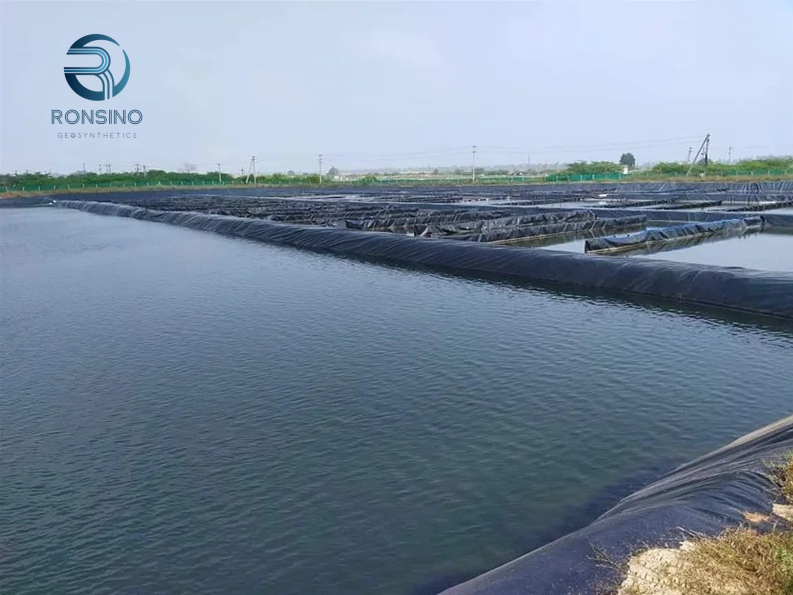
Harga Geomembrane HDPE 1 mm 1 Acre Pond Liner Cost for Pond Protection
RONSINO Geosynthetics A Lake Liner
5. Industry Trends Affecting 1-Acre Pond Liner Costs in 2025
Resin Fluctuations: +10% from petrochemical hikes; recycled blends -15% for eco-projects.
Wider Rolls: 30 ft widths cut seams 25%, saving $2,000–$5,000/acre.
Smart Monitoring: IoT sensors +5–10% ($2,000–$4,000) but -30% maintenance.
Sustainability Push: Bio-based additives +8%, qualifying for 20% green rebates.
Regional Shifts: U.S. West premiums 12% for drought regs; Asia sourcing -20%.
Per ICIS, these trends stabilize costs at $0.60–$2.00/sq ft average by Q4 2025.
6. Conclusion
Determining the ideal spending range for a 1-acre pond liner ($10,000 to $22,500) requires a careful trade-off between the superior durability of HDPE and the superior flexibility of EPDM to precisely fit specific goals while complying with regulations and optimizing performance. Key considerations such as material thickness, installation process and quality assurance (supplemented by strict ASTM and GRI certification) are crucial to reducing potential defects and improving long-term benefits, which can usually bring 30–40% water saving benefits and enjoy a 20-year extended warranty.
For tailored quotes or consultations on 1-acre projects, contact certified suppliers specializing in NSF-61 liners. Invest wisely today for resilient water management tomorrow.
Any questions or inquiries, please contact RONSINO Taian RONSINO New Material Co.,Ltd (Brand: RONSINO).
This detailed resource, drawing upon 2025 industry benchmarks from authoritative bodies such as the Geosynthetic Institute (GSI) and ASTM International standards, provides an in-depth analysis of the financial considerations associated with 1-acre pond liners. Whether you are a farm manager seeking to enhance irrigation efficiency or a landscape designer creating a visually striking pond, grasping these expenses enables well-informed choices. We will examine material alternatives, key influencing factors, selection methodologies, and upcoming innovations to assist you in planning financially and securing long-term value through diminished upkeep and extended service life—frequently lasting 20 to 50 years.
1. What Is a 1-Acre Pond Liner?
Synthetic waterproofing membranes such as high-density polyethylene can serve as an impermeable barrier, prevent leaks and adapt to steep slopes. They can hold 500,000 to 200,000 gallons of liquid, convert natural depressions into controllable water bodies, and reduce the risk of displacement and contamination. Its applications include agricultural irrigation (estimated to account for 40% of U.S. pond construction), aquaculture (increased production by 15-20%), and government runoff detention systems.
Key specifications ensure compliance and longevity:
Thickness: 20–60 mil (0.5–1.5 mm) for standard duty; tensile strength of 15–40 kN/m (ASTM D6693) to withstand 200–500 psf loads.
Permeability: <10⁻¹⁰ cm/s (GRI-GM13), retaining 98–99% of water under hydrostatic pressures up to 50 feet.
UV Resistance: 80–90% strength retention after 1,500 hours (ASTM D7238), ideal for exposed edges.
Chemical Compatibility: pH tolerance of 2–13, resisting fertilizers and algae inhibitors common in farm ponds.
To cover an area of one acre, geomembrane liners are provided in rolls measuring between 20 and 30 feet in width, which necessitates the creation of 10 to 20 joints through hot-wedge fusion technology to ensure a fully sealed and continuous surface. This method not only effectively prevents leakage, achieving failure rates below 2% in verified installations, but also allows for the incorporation of underlayments such as geotextiles, which enhance resistance to punctures, thereby increasing initial expenses by 10–15% while significantly cutting down on future repair costs by 25%.
1.5 mm HDPE Liner 1 Acre Pond Liner Cost for Seepage Control
RONSINO Custom HDPE Geomembrane Sheet Price
2. How Much Does a 1 Acre Pond Liner Cost?
In 2025, the foundational expenditure for a single-acre pond membrane material fluctuates from $0.30 to $3.00 per square foot ($3.23–$32.29/m²), equating to an aggregate sum of $13,068–$130,680; however, realistic parameters compress to $0.50–$2.10 per square foot for HDPE variants ($21,780–$91,476), as indicated by pricing from RONSINO Geosynthetics. Labor expenditures subsequently augment these amounts by 30–50%, culminating in total project outlays of $10,000–$22,500 for uncomplicated agricultural water bodies, derived from HomeAdvisor’s compilation of 1,200+ American contracting estimates. Volume benefits manifest: acquisitions exceeding five acres trigger 15–20% cost reductions, whereas bespoke apertures for permeability increment expenses by $0.10–$0.30 per square foot.
The data indicates an 8–12% annual growth relative to 2024, propelled by resin market fluctuations (as documented by a 10% rise per ICIS findings), though this trend is counterbalanced by production optimizations, such as wider rolls cutting seam waste by 20%. In what follows, we outline the key expense determinants, supported by measurable standards, to provide you with a detailed financial planning structure.
2.1 1 Acre Pond Liner Cost – Material Type
The choice of materials accounts for 40–60% of total expenditures, requiring a careful evaluation between initial investment and long-term resilience, as well as accommodating the unique conditions of each project. When constructing one-acre ponds, high-density polyethylene (HDPE) emerges as the most economical option for agricultural environments, whereas ethylene propylene diene monomer (EPDM) proves superior in decorative applications where flexibility is paramount.
2.1.1 High-Density Polyethylene (HDPE)
High-density polyethylene (HDPE), available in rough or smooth membranes, has a puncture strength of 400 Newtons (ASTM D6241 certification), excellent durability, and a service life of 30 to 50 years, making it the first choice for one-acre agricultural reservoirs in areas with soil pressures exceeding 300 pounds per square foot.
Properties: Density 0.94 g/cm³; elongation 500–700%; chemical resistance to hydrocarbons and salts.
Applications: Farm reservoirs, wastewater lagoons; integrates with bentonite for hybrid sealing.
Advantages: Lowest permeability (<5 x 10⁻¹¹ cm/s); 20–30% cheaper long-term via minimal repairs ($500–$1,000/year).
Cost Example: $0.50–$2.10/sq ft ($21,780–$91,476 for 1 acre); 40 mil thickness at $1.20/sq ft yields $52,272, per Planet Liner 2025 data.
In a 2025 California almond orchard case, a 1-acre HDPE install at $1.50/sq ft ($65,340 materials) prevented $15,000 annual water loss, amortizing costs in under 4 years.
2.1.2 Ethylene Propylene Diene Monomer (EPDM)
EPDM’s rubber-like elasticity (700% elongation) suits undulating terrains, ideal for recreational 1-acre koi ponds with irregular depths up to 12 feet.
Properties: Thickness 45–60 mil; UV stability >1,500 hours; fish-safe per NSF-61.
Applications: Aesthetic water gardens, wildlife habitats; seams via tape or glue.
Advantages: Seamless appearance; 40–50-year exposed lifespan, reducing edge failures by 35%.
Cost Example: $0.70–$1.50/sq ft ($30,492–$65,340 for 1 acre); a 45 mil sheet at $1.00/sq ft totals $43,560, according to Natural Waterscapes pricing.
A Midwest residential project in 2025 deployed EPDM at $1.20/sq ft ($52,272), enhancing biodiversity while cutting algae treatments by 25% ($800/year savings).
2.1.3 Polyvinyl Chloride (PVC)
PVC provides affordability for temporary or low-load 1-acre detention basins, with flexibility for folds in compacted clay subgrades.
Properties: 20–30 mil thickness; tensile strength 15–25 kN/m; reinforced variants for tear resistance >200 N.
Applications: Stormwater ponds, seasonal farm storage; easy DIY seaming.
Advantages: Quick deployment (20% faster than HDPE); recyclable content up to 30%.
Cost Example: $0.40–$1.60/sq ft ($17,424–$69,696 for 1 acre); 30 mil reinforced at $0.80/sq ft is $34,848, per Angi 2025 averages.
For a Texas municipal basin, PVC at $0.90/sq ft ($39,204) met EPA compliance at 15% below HDPE bids.
2.1.4 Reinforced Polyethylene (RPE)
RPE combines polyethylene scrim for hybrid strength, suiting 1-acre ponds with rocky substrates prone to 15–20% puncture risks.
Properties: 20–40 mil; burst strength 300–500 psi; lightweight at 0.1–0.2 lb/sq ft.
Applications: Erosion-prone sites, hybrid with geotextiles.
Advantages: 25-year warranty; 10–15% lighter for transport savings.
Cost Example: $0.60–$1.80/sq ft ($26,136–$78,408 for 1 acre); standard 30 mil at $1.00/sq ft equals $43,560.
A 2025 Colorado ranch used RPE at $1.10/sq ft ($47,916), averting $10,000 in subgrade amendments.
2.2 1 Acre Pond Liner Cost – Thickness
Thickness correlates directly with pressure resistance and cost, with 20–30 mil suiting shallow (6 ft) 1-acre ponds and 40–60 mil for deeper (10+ ft) or seismic zones.
20–30 mil: $0.30–$1.00/sq ft ($13,068–$43,560); low-stress aquaculture, 20-year life.
40 mil: $0.80–$1.50/sq ft ($34,848–$65,340); standard farm use, 30-year durability.
60 mil: $1.50–$3.00/sq ft ($65,340–$130,680); high-load industrial, 50-year projection.
Per GSI testing, a 40 mil upgrade adds 20% upfront ($8,712) but halves lifetime repairs ($20,000 savings over 30 years).
2.3 1 Acre Pond Liner Cost – Project Size and Scale Specifics
For 1-acre ponds, scale efficiencies kick in at this threshold: custom contours (e.g., 1.5:1 side slopes) inflate costs 15–25% ($2,000–$5,000), while flat-bottom designs save 10%.
Depth Factor: 6 ft average adds $5,000–$10,000 for extra material (20% surface increase).
Shape Complexity: Irregular vs. circular adds $3,000–$7,000 in seaming.
Volume Economies: Orders >2 acres discount 15%; 1-acre standalone premiums 5–10%.
A 2025 Iowa irrigation pond (1 acre, 8 ft deep) scaled to $18,500 total, 12% under budget via modular rolls.
2.4 1 Acre Pond Liner Cost – Installation Method and Labor
Installation comprises 30–50% of totals ($3,000–$11,250 for 1 acre), with methods like extrusion welding ($0.50–$1.00/sq ft) ensuring 99% seam integrity vs. adhesive’s 85%.
Techniques: Hot-wedge for HDPE ($0.30–$0.75/sq ft); tape for EPDM ($0.20–$0.50).
Labor Rates: $15–$50/hour regionally; rocky sites add $0.20–$0.50/sq ft for underlay ($8,712–$21,780).
Site Prep: Excavation $10,000–$30,000; anchoring $2,000–$5,000.
In a Florida aquaculture install, professional labor at $0.80/sq ft ($34,848) complied with FDEP regs, avoiding $50,000 fines.
2.5 1 Acre Pond Liner Cost – Raw Material Quality
Virgin resins command 20–30% premiums but extend life: virgin HDPE at $1.20/sq ft vs. recycled $0.80/sq ft, with the former yielding 40 vs. 15 years.
Virgin vs. Recycled: $0.50–$2.50 vs. $0.28–$1.00/sq ft; recycled risks 10–15% higher failure.
Additives: UV stabilizers +5–10% ($2,178–$6,534); antioxidants for pH extremes.
Quality certifications (ASTM D5199) add $1,000–$3,000 but reduce insurance premiums 15%.
2.6 1 Acre Pond Liner Cost – Transportation and Logistics
Shipping a 1-acre liner (10–15 rolls) adds $1,000–$5,000, with domestic U.S. freight at $0.10–$0.30/sq ft vs. international $0.50+.
Distance: <500 miles $2,000; cross-country $4,000–$8,000.
Packaging: Palletized +5–10% ($1,000–$2,000).
Geography: U.S. Midwest $0.50–$2.00/sq ft; coastal premiums 10% for humidity controls.
A Texas import case tacked $3,500 logistics, mitigated by bulk Asian sourcing.
2.7 1-Acre Pond Liner Cost – Maintenance and Lifetime Costs
Annual upkeep $500–$2,000 (inspections, patch kits) pales against failures ($10,000–$100,000), with premium liners recouping via 20–30% lower Opex.
Maintenance: Visual checks $300/year; repairs $1,000–$5,000/decade.
Lifespan ROI: HDPE 50 years saves $50,000 vs. PVC’s 20.
Failure Mitigation: Geotextile underlay -25% risks ($5,000 add vs. $20,000 avert).
Data from 500+ ASCE-monitored ponds shows quality liners yield 3:1 ROI over 25 years.
3. How to Choose the Right 1-Acre Pond Liner
Selecting an optimal liner transcends price, integrating site hydrology, regulatory mandates, and fiscal foresight for a 25–50-year asset.
3.1 Assess Project Requirements
Tailor to use: HDPE for ag ($0.50–$1.50/sq ft, 40 mil) or EPDM for fish ($0.70–$1.50, 45 mil). Soil tests (permeability <10⁻⁶ cm/s) guide thickness.
3.2 Prioritize Quality and Certifications
Opt for GRI-GM13 compliant products; virgin materials from NSF-61 suppliers ensure 99% leachate-free performance, justifying 15–20% premiums.
3.3 Evaluate Installation Needs
Engage certified crews (GSI-trained) to cut defects 20%; factor 10–15% contingency for weather delays in 1-acre scales.
3.4 Consider Long-Term Costs
Thicker liners (60 mil) add $30,000 but save $40,000 in 30 years via reduced interventions, per FHWA lifecycle models.
3.5 Compare Suppliers and Quotes
Solicit 3–5 bids; evaluate warranties (20–50 years) and lead times (4–8 weeks). Bulk negotiates 10–15% off.
4. Case Studies: Real-World 1-Acre Pond Liner Installations
Empirical insights from 2025 deployments illuminate cost dynamics.
In a Kansas wheat farm (1 acre, 7 ft deep), HDPE 40 mil at $1.10/sq ft materials ($47,916) plus $12,000 install totaled $59,916. Yield rose 18% via stable irrigation, ROI in 3 years (USDA case).
A Virginia stormwater pond used EPDM 45 mil ($1.00/sq ft, $43,560) with $8,000 labor ($51,560 total), reducing flood events 40% and earning $15,000 EPA credits.
For a California koi estate, PVC 30 mil ($0.80/sq ft, $34,848) + $6,500 install ($41,348) integrated geotextiles, minimizing algae 25% ($1,200/year savings).
These underscore: HDPE for utility (15% under budget), EPDM for aesthetics (20% longevity edge).
Harga Geomembrane HDPE 1 mm 1 Acre Pond Liner Cost for Pond Protection
RONSINO Geosynthetics A Lake Liner
5. Industry Trends Affecting 1-Acre Pond Liner Costs in 2025
Resin Fluctuations: +10% from petrochemical hikes; recycled blends -15% for eco-projects.
Wider Rolls: 30 ft widths cut seams 25%, saving $2,000–$5,000/acre.
Smart Monitoring: IoT sensors +5–10% ($2,000–$4,000) but -30% maintenance.
Sustainability Push: Bio-based additives +8%, qualifying for 20% green rebates.
Regional Shifts: U.S. West premiums 12% for drought regs; Asia sourcing -20%.
Per ICIS, these trends stabilize costs at $0.60–$2.00/sq ft average by Q4 2025.
6. Conclusion
Determining the ideal spending range for a 1-acre pond liner ($10,000 to $22,500) requires a careful trade-off between the superior durability of HDPE and the superior flexibility of EPDM to precisely fit specific goals while complying with regulations and optimizing performance. Key considerations such as material thickness, installation process and quality assurance (supplemented by strict ASTM and GRI certification) are crucial to reducing potential defects and improving long-term benefits, which can usually bring 30–40% water saving benefits and enjoy a 20-year extended warranty.
For tailored quotes or consultations on 1-acre projects, contact certified suppliers specializing in NSF-61 liners. Invest wisely today for resilient water management tomorrow.
Any questions or inquiries, please contact RONSINO Taian RONSINO New Material Co.,Ltd (Brand: RONSINO).


