HDPE Water Feature Liner for Shrimp Farming in the Philippines
case · 2026-01-13 · 0 views

Geomembrane pond liners are essential to the overall water retention, pond protection, and the health of shrimp or fish farming ponds. For shrimp and fish farm projects, HDPE geomembrane tank liners are the preferred lining option; as the true foundation of such aquaculture facilities, HDPE geomembrane liners are unrivaled as the best lining material.
HDPE Water Feature Liner are made of high polyethylene raw materials, adding 2%-3% of carbon black, anti-oxidation, anti-aging and UV-resistant ingredients, and are produced via top-tier automated equipment and a three-layer pressing process. Ideal for large-scale projects that require UV/ozone resistance, chemical tolerance or high-quality installation, these HDPE geomembrane pond liners offer great cost performance for exposed lining works. Their application scope covers aquaculture, solid waste containment, mining, water containment and biogas digester projects.
Case Study
Location – the Philippines
Products – HDPE Geomembrane Pond Liner
Application – Shrimp Pond in the Philippines
Issue
A Philippine customer reached out to us via Facebook, expressing the need to buy geomembrane pond liners for shrimp ponds and asking about the product prices. In the Philippines, shrimp farming is mostly located in coastal areas, thanks to the convenient access to brackish or seawater for pond use. The local coastal land is usually swampy or sandy, and sometimes contains organic soil. Such land is not fit for growing crops or running plantations, and its price is relatively low, so it is often used to build shrimp ponds. Yet there are drawbacks: ponds built on pyrite-bearing soils (possibly acid sulfate or active acid sulfate soils) will have low pH levels, which is problematic for shrimp farming. Sandy soil ponds have poor water retention; organic soil cannot maintain stable dikes and has high oxygen requirements. Moreover, the low-lying terrain makes it hard to drain and fully dry these shrimp ponds after harvest. If the pond bottoms remain undried, they will deteriorate after multiple farming cycles, causing stress to the shrimp and triggering disease outbreaks.
Solution
The Philippine shrimp farmer encountered the problems mentioned above, and after consulting our company, he was recommended to use a 0.5mm geomembrane pond liner. This product creates a separation between pond water and soil. Thanks to its durable, shatter-resistant properties, the HDPE water feature liner can not only block weeds, sludge and other obstructive pollutants from getting into the pond, but also lower the bacterial content in the pond environment, thereby reducing antibiotic usage. Moreover, the geomembrane guards pond slopes against erosion, and simplifies the maintenance work as well as the quick removal of sediment and waste. We sent the customer 0.5mm geomembrane samples for testing, and he was very satisfied with the test results before placing an order for the product to use in his shrimp farm. Our team also provided professional guidance on geomembrane installation for the customer. We put the customer’s needs first throughout the installation consultation, walked him through the detailed installation steps, and reminded him of three important considerations:
(1) Before laying the HDPE geomembrane, level and compact the target surface first. Also, get sandbags or other heavy objects ready to weigh down the liner after laying, avoiding wind-induced displacement.
(2) Keep the slope gradient of the breeding pond below 45 degrees—exceeding this angle will raise the risk of slope collapse and hinder daily aquaculture work.
(3) Dig the anchoring ditch as a U-shaped or inverted trapezoidal groove measuring 40–50 cm in depth, then fill it back with soil.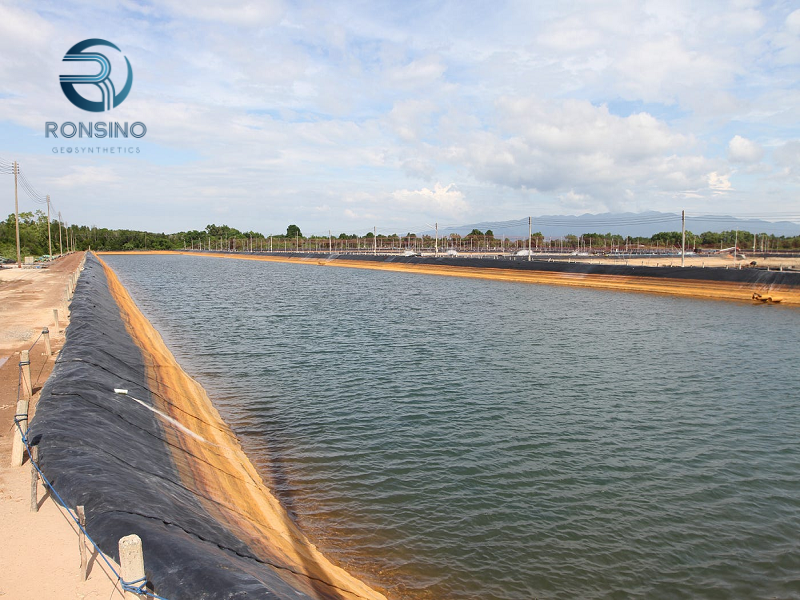
HDPE water feature liners have great flexibility, capable of satisfying the anti-seepage needs of different projects, with strong maneuverability, easy construction and low mechanical input.
They are low in cost and high in economic benefits. Practical calculations show that using this liner can save 30%–50% of the cost, when compared with common anti-seepage methods like reinforced concrete self-waterproofing and clay waterproofing for regular projects.
Made entirely from environmentally friendly materials, HDPE water feature liners achieve anti-seepage through physical means, without producing any toxic or harmful substances.
These liners feature a high anti-seepage coefficient, which can effectively overcome base surface uneven settlement. In environments free from direct sunlight, their service life can reach 30–50 years.
In addition, the liner construction process is rapid and efficient.
Specifications of Large Fish Pond Liners for Shrimp Farming in the Philippines
Total HDPE Pond LinerQuantity – 141012 square meters
Thickness– 0.5mm
Roll Size -7m* 280m
About RONSINO
Since its establishment in 2007, RONSINO has specialized in delivering one-stop geosynthetics products and solutions to global customers. We have provided a full spectrum of efficient, state-of-the-art products (geomembranes, geotextiles, geocells, GCLs, drainage boards, geogrids) to over 81 countries worldwide. Our clients are distributed across major regions including Australia, Europe, the Americas, Asia, the Middle East, and Africa—covering markets like the UK, Mexico, the Philippines, India, the UAE, Nigeria, and South Africa, among others.
RONSINO combines top-tier geosynthetic product manufacturing with professional design and installation services. We also cater to OEM, ODM, and custom development and fabrication demands. For any questions or inquiries, please fill out and submit the form below, and we will get back to you as soon as possible.


