HDPE Pond Plastic Sheet for Landfill Projects in Ghana
case · 2025-12-17 · 0 views

Case Analysis
Location: Ghana
Product: HDPE Pond Plastic Sheet
Application: Landfill Project
Advantages
1.Covering the landfill with high-density polyethylene (HDPE) geomembrane can significantly reduce the possibility of rainwater and other external water sources penetrating into the garbage dump, thereby significantly reducing the amount of leachate produced and achieving effective protection of the landfill environment;
2.The application of HDPE anti-seepage membrane can effectively control the diffusion of landfill odors, and systematically collect and utilize combustible gases generated above the landfill layer, thereby achieving the dual goals of pollution control and resource recycling;
3.The anti-seepage material can effectively curb the growth and spread of pathogenic microorganisms, while blocking the breeding pathways of harmful organisms such as mosquitoes and flies;
4.Landfill anti-seepage layer materials can prevent surface runoff from being polluted, avoid the scattering of garbage and direct contact with humans and animals, and reduce public health risks;
5.HDPE anti-seepage membrane has excellent anti-erosion properties and can effectively resist soil erosion caused by wind and rain;
6.By covering with HDPE geomembrane, the stabilization process of the landfill can be accelerated and its environmental recovery cycle can be shortened;
7.This material provides a basic platform for greening on the top of the landfill, provides soil support conditions for vegetation growth, and facilitates the ecological reuse of land after landfill.
Issue
With the rapid development of industry and the surge in waste volume, Ghanaian cities are facing a large amount of waste to be processed. The traditional methods of incineration and landfilling each have their own drawbacks, and landfilling is particularly serious. Leachate produced by the decomposition of garbage will pollute groundwater and the surrounding geological environment, and may spread to lower areas due to gravity, exacerbating ecological risks. Therefore, developing anti-leak technology is a primary challenge for modern landfill operations.
Solution
To mitigate the environmental contamination caused by hazardous waste byproducts, HDPE pond lining material serves a critical function. Within landfill sites, this HDPE liner not only provides exceptional impermeability but also exhibits remarkable flexibility to conform to uneven terrain. Most importantly, it demonstrates superior resistance to chemical degradation, thereby preventing toxic substances from infiltrating the soil and ensuring comprehensive safeguarding of groundwater resources.
(1) The landfill must immediately implement protective coverage according to the operation stage to ensure that daily coverage, intermediate coverage and final closure specifications are implemented.
(2) Daily covering materials can be soil (thickness 20–25cm), HDPE anti-seepage membrane (≥1.5mm) or LDPE geomembrane; slopes require plastic sheeting or fabric; alternative covering materials are as protective as soil.
(3) Use HDPE/LDPE film (≥1mm) or clay as the intermediate covering material; the synthetic film must be equipped with an air conduction system to ensure that the covering layer overlaps the drainage ditch and maintains the slope water flow path.
(4) HDPE anti-seepage membrane requirements: black film (≥1mm thick, ≥6m wide) or bentonite blanket (≥5mm thick). LDPE geomembrane can be used as a secondary choice for general waste; the daily film length is about 20m, and the intermediate film can reach 50m.
(5) After each layer of waste is landfilled, the rainwater and sewage drainage facilities must remain fully functional.
(6) Comprehensive deodorization is required in the operation area: covering exposed waste in a timely manner, sealing leachate tanks, optimizing biogas collection, timely drainage and regular disinfection of working surfaces.
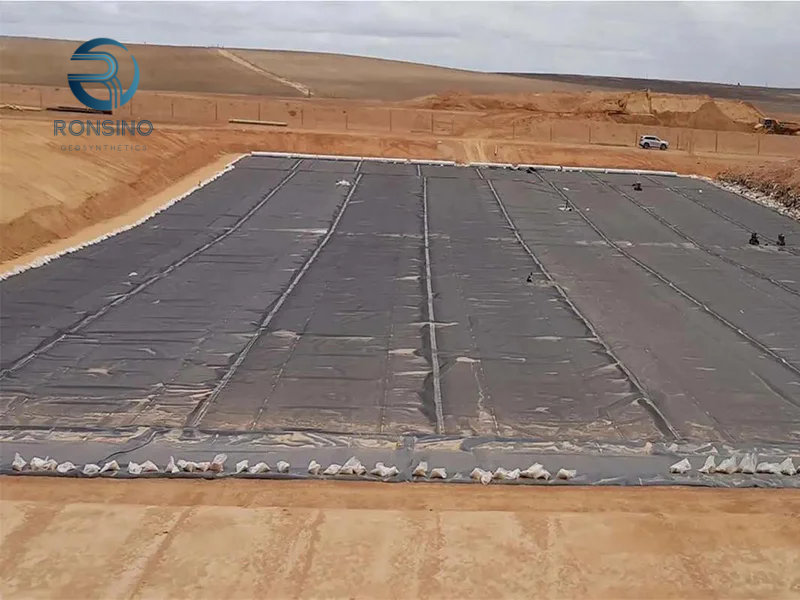
(7) Daily temporary coverage
Garbage areas that require secondary landfill must be covered with 1 mm thick high-density polyethylene (HDPE) geomembrane or materials of equivalent strength within seven days.Coverage arrangement: The installer must reduce the working area to less than half of the original range one hour before the end of daily work; after the end of the work, the entire area must be completely enclosed to ensure that no garbage is exposed.Membrane removal: The covering film can be removed only thirty minutes before the start of the daily working area, and the working area on that day must not exceed the specified range.
Addressing technical specifications: it is imperative that the high-density polyethylene (HDPE) pond liners are overlapped with precision, ensuring the overlap width measures between 100 to 120 millimeters, and the overlapping seams must be oriented in the direction of water flow. Following the installation of the HDPE geomembrane, adequate pressure must be applied by either cement pavers or vehicle tires to safeguard against displacement by wind forces, with the spacing between adjacent pavers restricted to a maximum of 2000 millimeters.
(8)Mid term coverage
Protective coverings must be installed on landfill areas that have been idle for more than seven days. This cover shall consist of a 1.5 mm thick HDPE geomembrane or equivalent material. After laying, cement square bricks or waste tires must be used to evenly ballast them to prevent displacement. The distance between them shall not exceed two meters. It is also necessary to use high-strength plastic ropes or geomembrane strips for reinforcement, which are welded to the geomembrane and fixed to the ballasted block to form a stable slope stabilization system.
Specifications of HDPE Pond Plastic Sheet for Landfill Projects in Ghana
Total Quantity – 110,000 sqm
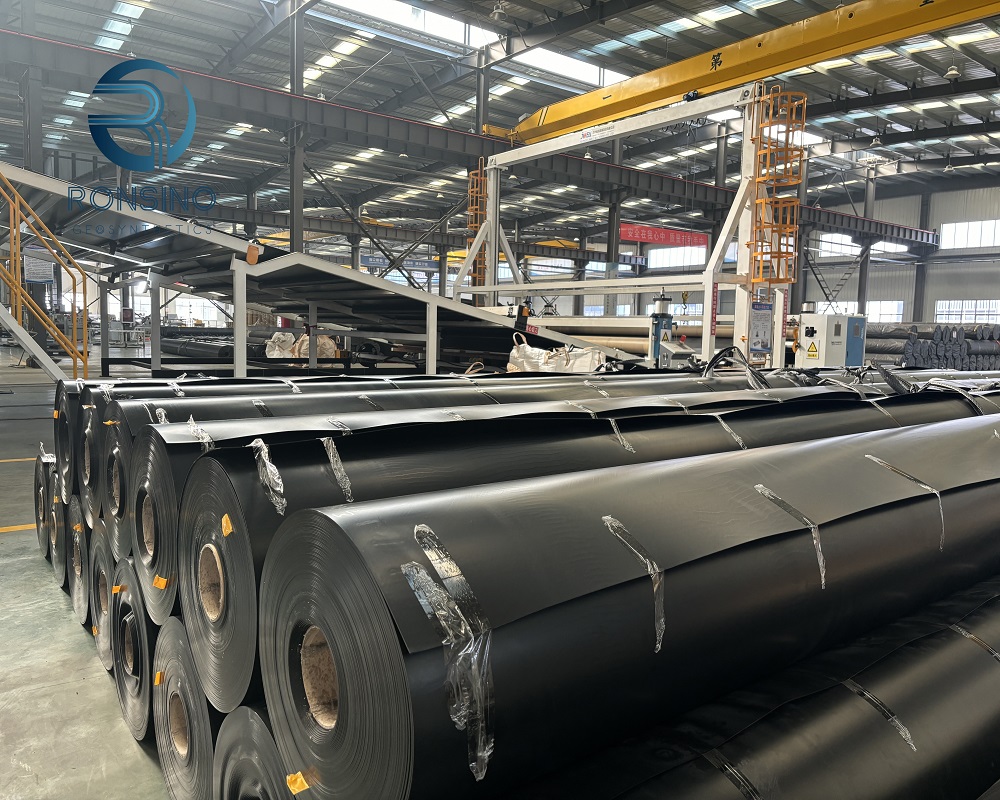
HDPE Landfill Liner specification-1.5mm
Roll size-7m*140m
Summarize
HDPE Pond Liner is an impermeable membrane made of advanced polymers, mainly containing 97.5% high-density polyethylene, 2.5% carbon black and various performance enhancers. Its excellent resistance to environmental stress cracking and chemical corrosion, wide temperature range stability and durability make it suitable for use in biogas digesters, tailings ponds, channel linings, dam waterproofing and underground traffic engineering and other fields.
About RONSINO
Since its establishment in 2007, RONSINO has been committed to providing comprehensive geosynthetic materials products and solutions to customers around the world. The company has supplied a variety of highly efficient and technologically cutting-edge geomembranes, geotextiles, geocells, geotechnical clay liners (GCLs), drainage panels and geogrids to more than 81 countries. Our core customer groups are located in Ghana, France, Sweden, the United Kingdom, Hong Kong, Hungary, New Zealand, Poland, Mexico, Ecuador, Brazil, Pakistan, Bangladesh, Thailand, Vietnam, Malaysia, Indonesia, Singapore, Philippines, Sri Lanka, India, United Arab Emirates, Saudi Arabia, Qatar, Kenya, Ghana, Ethiopia, Somalia, Nigeria, South Africa, Swaziland, Mongolia and other countries.
RONSINO is not only manufacturing best quality geosynthetic products but also providing professional design and installation service. OEM, ODM, custom development and fabrication are also available. If you have any questions or inquiries, please fill and submit the following form, we will reply as soon as possible.


