HDPE Pond Material Liner for Dam Project in the Philippines
case · 2026-04-24 · 0 views

CASE STUDY
Location – the Philippines
Product(s) – HDPE Pond Material Liner
Application – Dam Project
Issue
The rockfill embankment stands as the core component of the dam infrastructure. Its upstream side is carefully reinforced with a layer of stone riprap, which effectively safeguards against sediment erosion that might undermine the dam’s structural stability. Moreover, the surface is treated with a simple cement coating to improve its resilience. Following this, the Philippine client decided to lay an HDPE geomembrane lining along the entire slope surface.
Solution
As a high quality synthetic material,HDPE Pond Material Liner has been widely used in landfills, water storage structures, aquaculture, heavy industry, renewable energy and mining. Its outstanding properties include excellent impermeability, chemical resistance, stress crack resistance, low water permeability, good UV stability and low temperature flexibility, ensuring its long service life and reliable performance under various environmental conditions.
The RONSINO engineering team uses HDPE Pond Material Liner technology to reinforce open-air fault embankments. By constructing an efficient anti-seepage barrier, it blocks precipitation and prevents reduction in soil strength and structural instability, thereby significantly reducing landslide risks and effectively responding to slope instability caused by heavy rainfall.
Benefits
High-density polyethylene (HDPE) geomembrane is revolutionizing water conservancy anti-seepage technology with its excellent performance, but it still faces obstacles such as technology, construction and talent. In order to give full play to its effectiveness, it is necessary to optimize the plan, adapt to local conditions, and ensure the integration of materials and technologies to ensure water-saving projects.
Construction method of HDPE Geomembrane Pond Liner
Before commencing the placement of the impervious HDPE Pond Material Liner for sale, it is imperative to meticulously prepare the slope surface by meticulously grading it to a uniform condition, thereby eradicating any potential for abrupt structural collapse. Following this step, the underlying loose soil must be thoroughly enveloped by the impermeable membrane to guarantee its superior sealing efficacy.
1) The installation process should originate from the lowest elevation and advance in an ascending manner to guarantee a secure connection, preventing undue strain while incorporating a 1.50% margin to account for future settling and expansion. To meet the unique demands of the project, the gradient is implemented from the uppermost section downward to enhance alignment and structural integrity.
2) Adjacent longitudinal seams must not align horizontally; instead, they shall be offset by a minimum distance of one meter to ensure structural integrity and proper load distribution.
3) The longitudinal joint shall be more than 1.50M away from the dam foot and bending foot, and shall be set on the plane.
4) Slope first and then bottom.
5) When the slope is laid, the film spreading direction should be basically parallel to the maximum slope line.
Slope installation: Before deploying the anti-seepage geomembrane, it is necessary to accurately measure the dimensions of the construction area and transport the geomembrane of corresponding specifications to the anchoring trench accordingly. Construction should follow the principle of "top-down, segmented laying" to ensure that the upper and lower ends are firmly anchored.
Site bottom preparation: Before laying the anti-seepage geomembrane, the installation area must be carefully inspected and accurately mapped. According to the recorded size data, the anti-seepage geomembrane that has been cut to the appropriate size in the warehouse will be transported to the designated location. During the laying process, manual guidance should be used to ensure that the anti-seepage geomembrane moves and adjusts along the preset trajectory.
RONSINO HDPE textured geomembrane must be precisely positioned to ensure a smooth, wrinkle-free surface on all pool areas. Adjacent sheets require a minimum 10cm overlap to guarantee a strong, impermeable seal. Proper alignment and overlapping are critical for achieving a seamless finish.
Securing: Use sandbags to secure the RONSINO HDPE embossed geomembrane to prevent airflow displacement. Trench anchoring: Lay an impermeable barrier of specified length along the upper edge of the trench, leaving allowance for settlement and tension. Vertical seam: lift the upper panel and lower the lower panel to ensure a minimum overlapping edge of 15 cm. The bentonite protective layer must be laid manually and directionally after verification.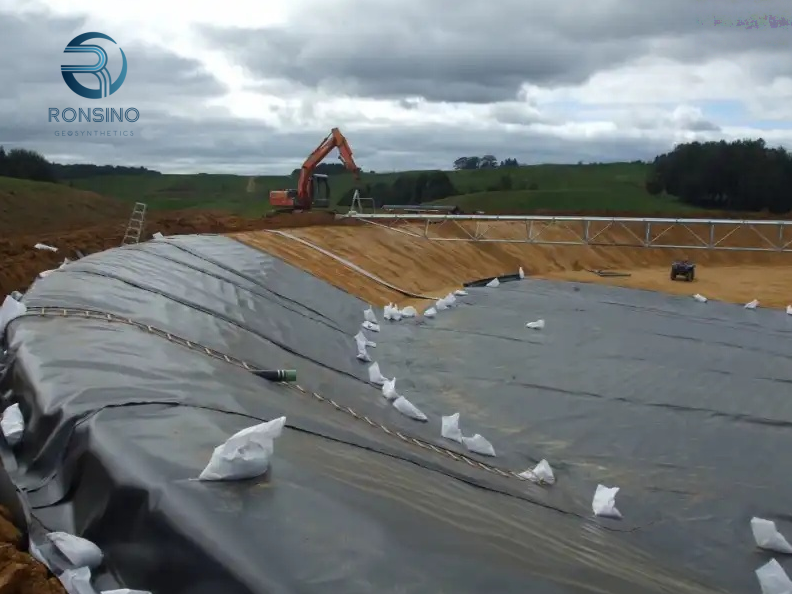
Specifications of HDPE Pond Material Liner for Sale for Dam Project in the Philippines
Total HDPE Pond Material Liner for Sale quantity – 150,000 squares meters
Thickness – 0.5mm
Each roll size – 8m*200m
About RONSINO
Since its inception in 2007, RONSINO has dedicated itself to delivering comprehensive geosynthetic materials products and solutions to clients across the globe. Driven by technological advancements and innovative approaches, the enterprise has distributed premium-grade geomembranes, geotextiles, geocells, bentonite waterproof blankets, drainage boards, geogrids, and similar high-quality items to 81 nations and territories, serving customer bases in Australia, Europe, Asia, Africa, and the Middle East.
RONSINO is dedicated to the manufacturing of high-quality geosynthetic products and provides extensive design and installation services. Additionally, we facilitate original equipment manufacturing (OEM), original design manufacturing (ODM), and customized development and fabrication services to meet diverse needs. For any questions or additional details, please fill out and return the enclosed form, and we will ensure a swift response to your inquiry.


