HDPE Impermeable Membrane for Salt Evaporation Pond Project in Bolivia
case · 2025-09-26 · 0 views
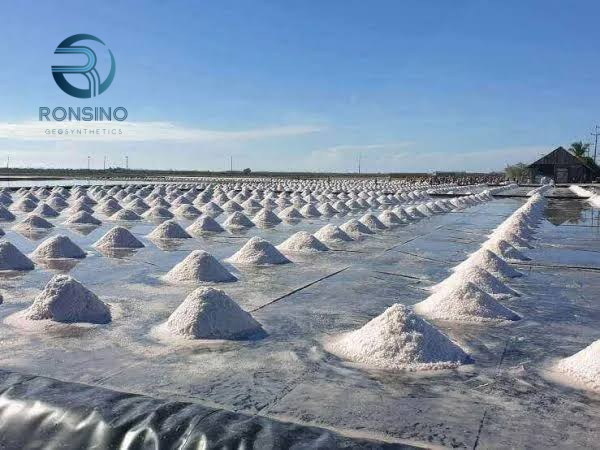
HDPE geomembrane is a high-quality geosynthetic material that provides the best and cost-effective solution for salt evaporation ponds. It is made using a three-layer co-extrusion blown film process and contains about 2% carbon black and anti-aging and anti-UV additives. The material has excellent chemical corrosion resistance, UV resistance, impermeability, high strength and excellent welding strength, making it suitable for various anti-seepage projects, such as aquaculture, reservoirs, wastewater treatment, mines and landfills.
Case Study
Country – Bolivia
Product – HDPE Pond Liner Fabric
Purpose – Salt evaporation pond
1.Benefits
The base surface of the HDPE plastic liner construction requires that the surface of the installation base should be tamped and leveled, and sharp objects such as tree roots, stones, glass and iron nails should be removed; the internal and external corners of the base should be trimmed and rounded, and the fillet radius ≥50cm, and the surface of the welding seam should be cleaned. Clean; the construction of geomembrane can be carried out after the acceptance and signature of the civil engineering and supervision construction party;
The laying of geomembrane must meet specific environmental conditions: the temperature must not be lower than 5°C. High-density polyethylene (HDPE) liners shrink at low temperatures and expand at high temperatures. Therefore, the geomembrane should be stretched by 2% to 5% before laying to adapt to the site conditions. Construction should be avoided in bad weather, especially when the wind exceeds Beaufort Scale 4 or rain or snow occurs. If wind force may damage the geomembrane, the adjacent parts to be welded need to be firmly fixed with heavy objects (such as boulders or sandbags).
2.Issue
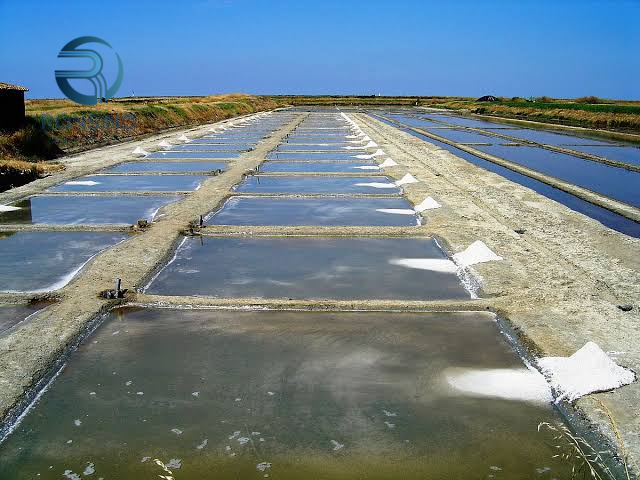
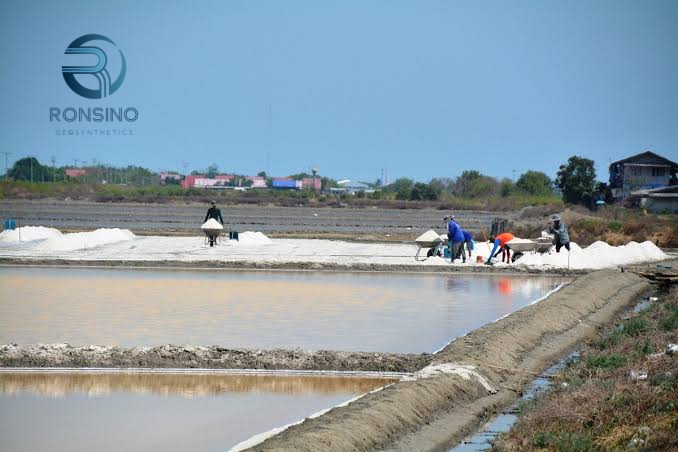
A request for geomembrane was submitted by a client from Bolivia via our Google platform. The customer inquired whether our high-density polyethylene (HDPE) geomembrane lining was suitable for their salt crystallization pond initiative. Detailed discussions revealed that the client employs conventional salt extraction techniques. In this method, seawater serves as the primary raw material, channeled into evaporation basins. Subsequent evaporation, lasting approximately 25 to 28 days, allows salt crystals to form. These crystals are then transported to drying platforms, where they cure for an additional 4 to 10 days, a process duration influenced by prevailing weather conditions.
In this way, customers can produce and harvest salt three times a year. Using this traditional method of sun-dried sea salt, the problem is that the output is low, and the customer wants to increase the output of the salt field under the same conditions, thereby increasing the income.
3.Solution
We suggested our 60-millimeter high-density polyethylene geomembrane to the client for application in his brine crystallization pond endeavor. Given the corrosive nature of the brine within the evaporation pond, it is imperative to employ a premium-grade, fully virgin-material geomembrane liner at the pond's base to prolong its operational lifespan and mitigate environmental consequences. The utilization of HDPE geomembrane lining serves as the primary barrier against seepage in salt ponds. Under favorable meteorological conditions, the daily salt yield can typically experience an enhancement of approximately 60% compared to standard daily outputs.
Based on the specifications provided by our client regarding the dimensions of their salt evaporation pond, our team determined that a total of 48,825 square meters of 60mil HDPE geomembrane would be required. We extended to the client our most competitive pricing for the 60mil HDPE geomembrane, complemented by a portfolio of our successful salt pond projects, and also offered comprehensive guidance on the installation procedures. The client expressed significant satisfaction with our extensive professional expertise and the exceptional quality of our products. Consequently, we supplied the client with a detailed test report for the 60mil HDPE geomembrane, an official factory certificate, and complimentary sample materials. Upon reviewing the samples, the client was highly pleased, which led to the prompt placement of an order with us.
4.Specification of HDPE Pond Liner Fabric for Salt Evaporation Pond in Bolivia
HDPE plastic liner thickness–60mil
Total Quantity–48825 Square meters
Each roll Size – 7m*155m
Standard – ASTM GM13 standard
When installing HDPE geomembrane, the joints should be laid parallel to the contour of the base and conform to the natural slope. It is necessary to minimize the number of welded seams while strictly controlling quality to optimize material utilization and strengthen quality control. In areas of geometric irregularity or transitions, joint lengths should be as short as possible. Specific installation requirements: On slopes with a slope exceeding 1:6, the joints should not be within 1.5 meters of the upper edge, and should avoid structural stress concentration areas.
During the laying of high-density polyethylene (HDPE) geomembrane, artificial wrinkles must be strictly prohibited. When the ambient temperature is low, effective measures should be taken to fully stretch the membrane and ensure its surface is flat. After the geomembrane is laid, the walking of people and the movement of tools and equipment on the surface of the membrane should be minimized. Any items that may cause damage to the geomembrane must not be placed on the surface of the membrane or dragged on it to prevent accidental damage to the geomembrane.
Before construction, the surface integrity of the high-density polyethylene (HDPE) geomembrane needs to be carefully checked, and problems such as mechanical damage, production defects, holes or cracks should be recorded and repaired. At the same time, precise size measurements are performed according to design requirements to ensure accurate cutting. The overlap width of adjacent membrane panels must be maintained at 10 to 15 cm, and the direction of the joint must be parallel to the contour line at the bottom of the slope to facilitate installation down the slope.
Moreover, to enhance the reliability of the HDPE geomembrane installation, careful attention must be paid to the laying process, ensuring that the material is not excessively stretched but rather retains some flexibility for thermal expansion and contraction. Additionally, it is imperative to ensure that a robust protective layer is adequately applied over the geomembrane to shield it from potential harm caused by heavy or sharp objects. These measures are critical to maintaining the integrity and longevity of the geomembrane system.
5.About RONSINO
Since its establishment in 2007, RONSINO has been committed to providing one-stop geosynthetic product and service solutions to global customers. The company has successfully developed and supplied a variety of high-efficiency cutting-edge products, and its business covers 81 countries and regions around the world. Its core customers are mainly located in Australia, France, Sweden, the United Kingdom, etc.
RONSINO is not only manufacturing best quality geosynthetic products but also providing professional design and installation service. OEM, ODM, custom development and fabrication are also available. If you have any questions or inquiries, please fill and submit the following form, we will reply as soon as possible.


