HDPE Geomembrane Sheet for Tailings Treatment Project in Chile
case · 2025-10-24 · 0 views

HDPE Geomembrane Sheet, also known as HDPE geomembrane liner, is a waterproof barrier material based on high molecular polymer. Geomembrane liner mainly can be divided int low-density polyethylene (LDPE) geomembrane, high-density polyethylene (HDPE) geomembrane liner and EVA geomembrane. RONSINO is the lading HDPE geoemembrane manufacturer and supplier, we wholeslae geomembrane liner with compelete size and thickness at compelete factory price.
1.What Are Advantages of HDPE Membran for Tailings Treatment Project
When considering a tailings treatment project in Chile, choosing RONSINO HDPE Geomembrane Sheet offers several advantages.
1.1 Chemical Resistance
RONSINO HDPE geomembrane has excellent chemical resistance and can resist the erosion of harmful substances such as sulfides contained in tailings. This excellent anti-corrosion property effectively ensures the structural stability of the liner system, thereby eliminating the risk of heavy metals and other toxic components leaking into the surrounding ecological environment.
1.2 Impermeability
With its excellent anti-penetration performance, HDPE geomembrane can effectively block the diffusion of harmful substances in tailings to surrounding soil and groundwater, thereby effectively ensuring the purity and safety of the regional ecological environment and water resources.
1.3 Durability
RONSINO HDPE geomembrane sheets are known for their excellent durability and long service life. The material is able to withstand harsh natural environmental challenges, such as ultraviolet radiation, extreme temperature fluctuations and external impact, ensuring that it maintains structural integrity and functionality as an impermeable layer throughout its life cycle.
1.4 Easy Installation
The installation process of HDPE Geomembrane Sheet is relatively straightforward and efficient. This allows for faster project completion and reduces labor and installation costs.
1.5 Cost-Effectiveness
RONSINO HDPE Geomembrane Sheet offers a cost-effective solution for tailings treatment projects. Its durability and low maintenance requirements contribute to long-term cost savings.
RONSINO HDPE Geomembrane Sheet for the tailings treatment project can ensure the containment and safe management of tailings materials.
2.What Is HDPE Geomembrane Sheet?
HDPE Geomembrane, widely recognized as a high-density polyethylene (HDPE) impermeable barrier, serves as a fundamental component in numerous engineering applications, particularly for containment and lining systems. Esteemed globally, it stands as one of the most prevalent geomembrane liners utilized across diverse sectors.
This specialized membrane demonstrates outstanding resistance to a broad spectrum of chemical agents, ensuring its reliability in challenging environmental conditions. It exhibits remarkable tensile strength relative to its thickness, providing robust structural integrity. Furthermore, HDPE Geomembrane maintains superior thermal stability, enabling it to endure elevated temperatures more effectively than alternative geomembrane materials.
A hallmark of HDPE Geomembrane is its extraordinary resistance to chemical corrosion, making it exceptionally well-suited for demanding containment applications in industries such as mining, agriculture, waste management, and water treatment. Its ability to withstand prolonged exposure to ultraviolet (UV) radiation without significant degradation ensures extended service life, enhancing its cost-efficiency for long-term projects.
Although HDPE Geomembrane exhibits reduced flexibility compared to linear low-density polyethylene (LLDPE), its superior tensile strength and durability make it the material of choice for applications where mechanical resilience and chemical inertness are critical. Its adaptability and economic viability position it as the preferred solution for lining projects across multiple industries.
HDPE Geomembrane Sheet is a geotechnical impermeation material engineered from a composite structure, comprising a plastic film as the primary impermeation layer and reinforced with non-woven fabric. It functions as a high-performance waterproofing construction material, effectively preventing fluid infiltration and moisture penetration.
Manufactured through an extrusion blow molding process, HDPE Geomembrane Sheet incorporates additives such as carbon black masterbatch, anti-aging agents, antioxidants, UV absorbers, and stabilizers into polyethylene resin. This formulation ensures enhanced durability and performance. It is extensively employed in the construction of warehouses, dams, cofferdams, canals, artificial lakes, and reservoirs, among other hydraulic engineering projects.
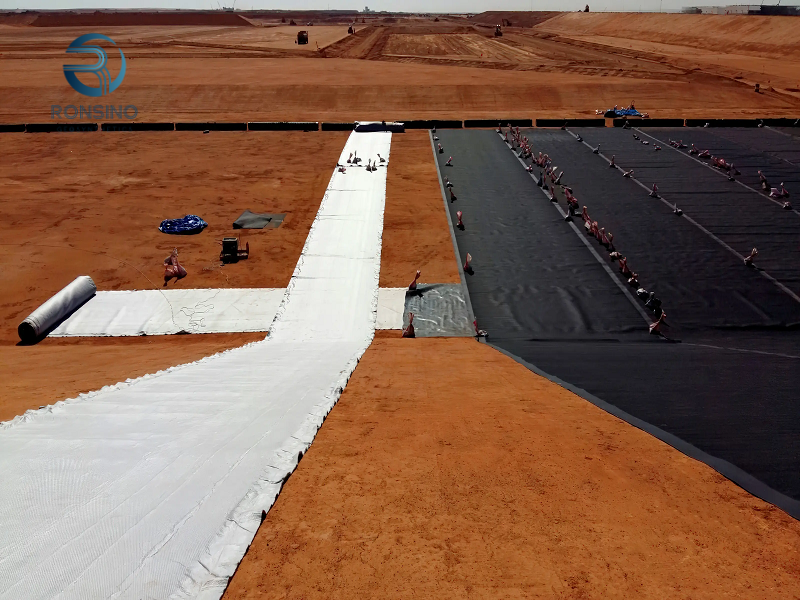
3.Case Study of HDPE Geomembrane Sheet Chile for Tailings Treatment Project
Location – Chile
Product(s) – HDPE membrane liner
Application – Tailings treatment project
Specification: 2.0 mm
Roll Size: 8m×105m
Quantity: 99960 square meters
4.HDPE Membrane Installation Process
4.1 HDPE Geomembrane Welding Machine
High-density polyethylene geomembrane welding equipment mainly includes two categories: double-track welding machine and extrusion welding machine. The double-track welding machine is mainly used to handle long-distance splicing operations between membrane materials. When the splicing spacing exceeds 50 cm, such equipment needs to be used, and the overlapping width of the two membrane materials should be controlled within 12 cm, and a construction deviation of ±2 cm is allowed. When the equipment is running, the welding temperature needs to be maintained between 370 and 420 degrees Celsius, but the specific temperature setting and welding speed need to be dynamically adjusted according to the actual thickness of the membrane material.
Single-rail extrusion welding technology is mainly used for repairing or hole processing in areas where dual-rail welding equipment cannot operate. At this time, the overlap width of the membrane material is required to be 5 cm, and the construction error is also controlled within ±2 cm. The standard repair process includes five key steps: precise cutting of the damaged area, hot air pre-pressure positioning, interface roughening, single-rail extrusion welding operation, and final strength inspection.
In view of the limitations of the extrusion welding process in temperature and pressure control accuracy, its welding quality stability is usually not as good as that of the dual-track welding process, so it is not recommended to use this technology on a large scale in the main project.
4.2 HDPE Geomembrane Installation Process
The site needs to be accurately measured before installation to optimize material cutting and reduce waste; when laying HDPE membrane, the number of welds should be minimized.
The longitudinal welds of the dam slope must be at least 1.5 meters away from the bottom of the slope and the bending point, and should be placed on the bottom plane of the pool first. PE film joints must be connected in a T shape, cross shapes are prohibited, and the distance between adjacent T-shaped welds is ≥1 meter.
If the weld is contaminated by condensation, moisture or impurities, it must be treated before welding. Welds should be smooth and even, with no slippage or offset.
When the membrane materials need to be spliced, the horizontal seams should be welded first and then the vertical seams. The distance between the horizontal seams should be >50 cm and should be maintained in a T shape. Cross shapes are prohibited; horizontal welding on the pool wall is prohibited.
The welding seam should be as straight as possible, and the welding seam can be shortened or avoided at corners or deformations. The overlap width of the double welding machine is recommended to be 12 cm. The membrane material must be laid flat and tight to avoid wrinkles to ensure a perfect overlap.
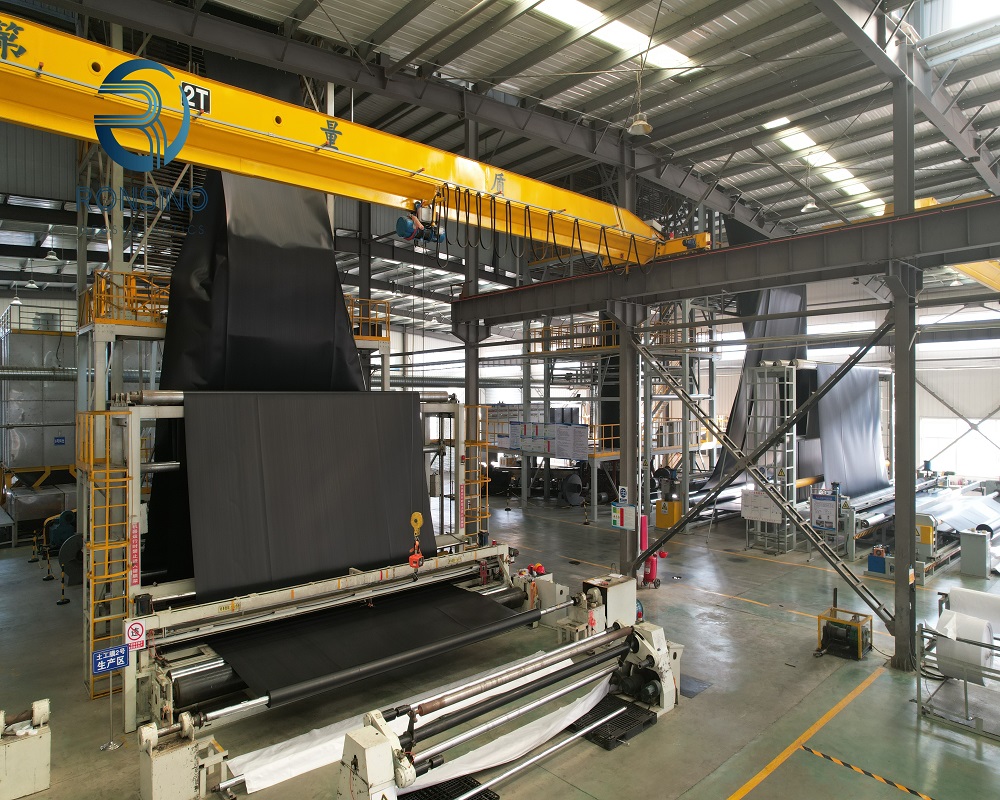
5.Solution of HDPE Membran for Tailings Treatment Project in Chile
In the anti-seepage system of tailings dams or tailings ponds, the use of geomembranes can effectively protect the environment and prevent soil and groundwater pollution. We provide geotechnical materials according to the needs of customers’ projects, and provide installation guidance.
5.1 Site Foundation Treatment
Before installing HDPE geomembrane, the base layer must be fully inspected. The base layer must be stable and flat, and vegetation roots, debris, turquoise, concrete blocks, steel bars, glass and other debris must be thoroughly removed to avoid damaging the integrity of the geomembrane. It is necessary to use a road roller to compact the base layer, eliminate mechanical or pedestrian marks and undulations, and smooth or compact all ridges. If it is laid on backfill soil, the compaction degree of the backfill soil must reach more than 95% of the maximum dry density. The base soil must not have signs of contamination such as water seepage, silt, stagnant water or organic matter. All internal corners and corners of the foundation must be made into smooth arcs with a radius of curvature of not less than 500 mm to prevent stress concentration on the membrane body.
5.2 The environmental conditions for the laying of the bottom HDPE Geomembrane Sheet
The ambient temperature usually needs to be maintained above 5°C. Be extra cautious during low-temperature construction and ensure that the geomembrane is in a moderately tense state, while in high-temperature environments it needs to be appropriately relaxed to adapt to the thermal expansion and contraction characteristics of the material; leaving a 200mm fold at the connection between the bottom of the pool and the inner slope can enhance the temperature adaptability of the membrane material.
During construction, the wind level should be controlled below level 4. Strong winds will significantly delay the progress of the project and damage the construction quality. Changes in wind force directly affect the laying stability of the geomembrane. Therefore, after the base membrane is laid, sandbags must be used to ballast and fix the HDPE geomembrane to ensure the firmness of the welded parts.
There should be no sharp and hard objects on the surface of the paving area. If such obstacles are found, they must be completely removed manually and covered with plain soil. According to the actual conditions on site, it is recommended to use the "push laying method" from the top of the pool along the dam slope to lay the membrane material. This method can effectively reduce the difficulty of construction and significantly improve operating efficiency.
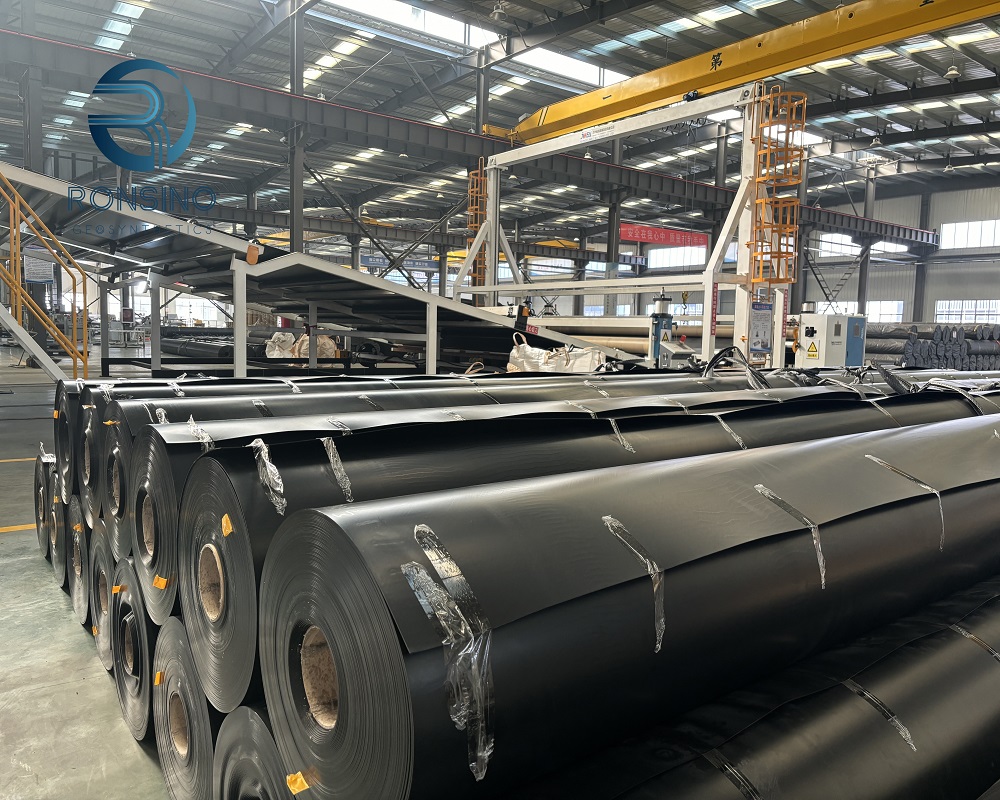
About RONSINO Geomembrane
RONSINO has been specializing in delivering one stop geosynthetics products and solutions to worldwide customers since its foundation in 2007. RONSINO had provided many types of effective and state of the art geomembranes, geotextiles, geocells, geosynthetic clay liners (GCLs), drainage boards, geogrids to over 81 countries.
RONSINO is not only manufacturing best quality geosynthetic products but also providing professional design and installation service. OEM, ODM, custom development and fabrication are also available. If you have any questions or inquiries, please contact us, we will reply as soon as possible.


