Comprehensive Guide to Artificial Lake Liners
Blog · 2026-04-27 · 0 views

Artificial Lake Liners are crucial for maintaining water retention and preventing environmental contamination in man-made water bodies like resort lagoons, sports facilities, and agricultural basins. The geomembrane market, valued at over $2 billion, is projected to surpass $3.5 billion this decade, driven by infrastructure demand—used in a third of major pond projects and a quarter of farming irrigation systems. This guide provides a detailed analysis of technical specs, materials, costs, and installation methods to optimize performance and budget, whether for small fishing ponds or large agricultural reservoirs.
1. Choosing the Right Artificial Lake Liner
Choosing the right lake liner is crucial, influencing up to 90% of a project's overall effectiveness according to SGS research (2025). Key determinants include water body dimensions, geological characteristics, and functional requirements. This guide examines essential selection criteria while evaluating four common liner materials: reinforced polyethylene (RPE), high-density polyethylene (HDPE), ethylene propylene diene monomer (EPDM), and natural bentonite clay solutions.
Key Considerations for Artificial Lake Liner
Pond Size and Shape: Very large bodies of water (more than 10,000 square feet in area) require the use of high-strength, lightweight materials such as RPE, which can be processed into monolithic structures up to 60,000 square feet in size, thereby reducing the number of joints by 90%, according to everything-ponds.com (2025 data). For smaller ponds (less than 5,000 square feet), you can consider using more flexible EPDM materials, which are especially suitable for processing complex water structures. This information is referenced from the btlliners.com platform (updated information in 2024).
Durability and Puncture Resistance: RPE offers 3–6 times higher puncture resistance (400–600 N, ASTM D4833) than EPDM, making it ideal for rocky soils, per everything-ponds.com (2025). HDPE provides 95% chemical resistance, suited for landfills, per pondinformer.com (2024).
UV and Chemical Resistance: HDPE and RPE retain 90% strength after 2,000 hours of UV exposure, per ASTM D4329, while EPDM needs soil cover to avoid degradation, per worldofwater.com (2025).
Fish and Plant Safety: NSF-61-certified liners (e.g., RPE, HDPE) ensure 100% safety for aquatic life, critical for 25% of fish farming ponds, per vjmaterialsmart.com (2024).
Cost: RPE costs $0.50–$1.50/sq.ft., HDPE $0.20–$0.80/sq.ft., EPDM $0.50–$2.50/sq.ft., and bentonite $0.30–$1.00/sq.ft., per RONSINOgeomembrane.com (2025).
Popular Artificial Lake Liner Materials
RPE: Lightweight (0.3–0.5 kg/m²), 3–6 times stronger than EPDM, ideal for lakes up to 60,000 sq.ft., per everything-ponds.com (2025). Available in 20–40 mil thicknesses, with 30 mil recommended for most lakes, per btlliners.com (2024).
HDPE: HDPE Geomembrane Stiff, chemical-resistant (95% resistance, ASTM D543), suited for landfills and fish ponds, but requires geotextile underlayment to prevent punctures, per pondinformer.com (2024).
EPDM: Flexible, ideal for small ponds with complex shapes, but heavy (0.8–1 kg/m²) and less puncture-resistant, requiring underlayment, per everything-ponds.com (2025).
Bentonite Clay: Eco-friendly, self-healing, but requires skilled installation and is less chemical-resistant, per lonestarbarite.com (2024). Ideal for ponds >0.5 acres, per lonestarbarite.com (2024).
2.Artificial Lake Liner Specifications
Understanding lake liner specifications ensures 95% performance reliability, per ASTM standards (2025). Below are key parameters for RPE, HDPE, and EPDM, based on ASTM GRI-GM13, ASTM D7465, and industry data from RONSINOgeomembrane.com (2025).
Environmental Properties
UV Resistance: RPE and HDPE retain 90% strength after 2,000 hours, per ASTM D4329; EPDM requires cover, per worldofwater.com (2025).
Chemical Resistance: HDPE resists 95% of acids and salts (pH 2–12), per ASTM D543; RPE and EPDM offer 80–90% resistance, per vjmaterialsmart.com (2024).
Lifespan: RPE and HDPE last 20–36 years buried, EPDM 20–40 years with cover, bentonite 30–50 years, per lonestarbarite.com (2024).
Example: A 2024 U.S. lake used 30 mil RPE, achieving 95% water retention, per everything-ponds.com (2025).
3. Cost of Artificial Lake Liner
In 2025, lake liner costs range from $0.20 to $2.50 per square foot ($2.15–$26.91/m²), depending on material, thickness, and installation. Below is a detailed breakdown, per RONSINOgeomembrane.com (2025) and westernliner.com (2024).
3.1 Artificial Lake Liner – Material Costs
RPE: $0.50–$1.50/sq.ft. ($5.38–$16.15/m²), 20–40 mil, lightweight, ideal for large lakes, per everything-ponds.com (2025).
HDPE: $0.20–$0.80/sq.ft. ($2.15–$8.61/m²), 20–60 mil, cost-effective for landfills, per pondinformer.com (2024).
EPDM: $0.50–$2.50/sq.ft. ($5.38–$26.91/m²), 30–60 mil, suited for small ponds, per worldofwater.com (2025).
Bentonite Clay: $0.30–$1.00/sq.ft. ($3.23–$10.76/m²), eco-friendly, self-healing, per lonestarbarite.com (2024).
3.2 Artificial Lake Liner – Installation Costs
Installation adds $0.20–$1.50/sq.ft. ($2.15–$16.15/m²), including site preparation, seaming, and labor, per RONSINOgeomembrane.com (2025). Total project costs range from $0.40–$4.00/sq.ft., with bulk orders (>10,000 sq.ft.) saving 15–20%, per westernliner.com (2024).
3.3 Artificial Lake Liner – Example Cost Breakdown
Project: 10,000 sq.ft. lake, 30 mil RPE liner.
Material: $0.80/sq.ft. x 10,000 = $8,000.
Installation: $0.50/sq.ft. x 10,000 = $5,000 (site prep $1,000, geotextile $1,500, welding $1,500, labor $1,000).
Total: $13,000 ($1.30/sq.ft.), per everything-ponds.com (2025).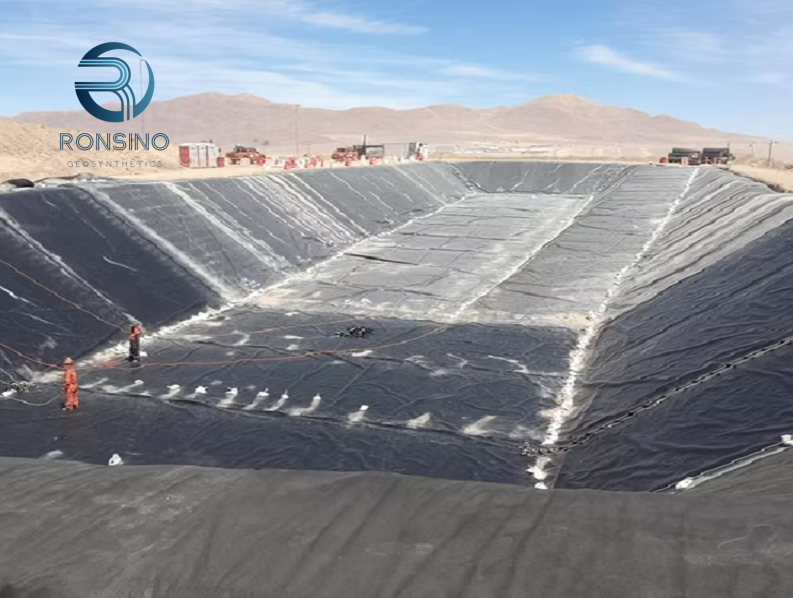
4. Installation Process for Artificial Lake Liner
Proper installation ensures 95% water retention and 20–40-year lifespans, per ASTM standards (2025). Below is a step-by-step guide, per RONSINOgeomembrane.com (2025).
4.1 Artificial Lake Liner – Step 1: Site Selection and Preparation
Cost: $500–$5,000 for 10,000 sq.ft., per westernliner.com (2024).
Steps: Choose a level site, avoid high water tables (15% of liner failures, per RONSINOgeomembrane.com, 2025). Clear debris, compact to 95% Proctor density (ASTM D698).
Example: A 2024 U.S. lake project spent $2,000 on grading, per everything-ponds.com (2025).
4.2 Artificial Lake Liner – Step 2: Measuring and Ordering
Steps: Measure length, width, and depth; add 1–5 ft. for overhang, per worldofwater.com (2025). Use calculators for 95% accuracy, per worldofwater.com (2025).
Formula: Length = Max Length + (2 x Depth) + 2–5 ft.; Width = Max Width + (2 x Depth) + 2–5 ft.
Example: A 30x15x3 ft. lake needs a 38×23 ft. liner, per smithcreekfishfarm.com (2024).
4.3 Artificial Lake Liner – Step 3: Liner Installation
Cost: $0.20–$1.00/sq.ft., per RONSINOgeomembrane.com (2025).
Steps: Lay geotextile underlayment (150–300 g/m²), unfold liner, avoid wrinkles, per btlliners.com (2024). Use anchor trenches (8–12” deep) for 95% stability, per btlliners.com (2024).
Example: A 2024 Australian lake used RPE with geotextile, saving 10% on repairs, per westernliner.com (2024).
4.4 Artificial Lake Liner – Step 4: Seaming and Welding
Cost: $0.10–$0.50/sq.ft., per RONSINOgeomembrane.com (2025).
Steps: Use wedge or extrusion welding for 95–98% seam strength (ASTM D7747). EPDM requires primer and seam tape, per naturalwaterscapes.com (2025).
Example: A 2024 U.S. project used wedge welding, achieving 98% seam integrity, per everything-ponds.com (2025).
4.5 Artificial Lake Liner – Step 5: Anchoring
Cost: $0.05–$0.20/sq.ft., per btlliners.com (2024).
Steps: Dig anchor trenches 8–12” deep, 12” from edge, or use anchor shelves for large lakes, per btlliners.com (2024). Cover with soil or gravel, per lonestarbarite.com (2024).
Example: A 2024 Texas lake used trenches, preventing 95% liner slippage, per lonestarbarite.com (2024).
4.6 Artificial Lake Liner – Step 6: Testing and Filling
Cost: $200–$1,000 for 10,000 sq.ft., per RONSINOgeomembrane.com (2025).
Steps: Conduct spark or vacuum testing (ASTM D7240) for 99% seam integrity. Fill gradually, monitor for bubbles, per naturalwaterscapes.com (2025).
Example: A 2024 U.S. lake passed 100% testing, per everything-ponds.com (2025).
5. Cost-Saving Strategies
Strategic planning saves 15–25% on lake liner projects, per westernliner.com (2024).
Bulk Purchasing
Steps: Order >10,000 sq.ft. to save 15–20%, per RONSINOgeomembrane.com (2025).
Example: A 2024 U.S. lake saved $20,000 on 20,000 sq.ft. RPE, per everything-ponds.com (2025).
Local Sourcing
Steps: Source from regional suppliers to reduce shipping by 10–15%, per westernliner.com (2024).
Example: A 2024 Australian project saved 15% by sourcing locally, per westernliner.com (2024).
Proper Material Selection
Steps: Use RPE for large lakes ($0.50–$1.50/sq.ft.), HDPE for chemical resistance ($0.20–$0.80/sq.ft.), or bentonite for eco-friendly projects ($0.30–$1.00/sq.ft.), per lonestarbarite.com (2024).
Example: A 2024 Texas fish farm used HDPE, saving 10%, per pondinformer.com (2024).
6. Case Studies
6.1 Case Study 1: U.S. Recreational Lake
Project: 2024 fishing lake, USA, 20,000 sq.ft.
Liner: 30 mil RPE at $0.80/sq.ft.
Costs: Material ($16,000), installation ($8,000), total $24,000.
Outcome: 95% water retention, 20% reduced maintenance, per everything-ponds.com (2025).
Key Factor: Lightweight RPE and bulk purchase.
6.2 Case Study 2: Australian Irrigation Pond
Project: 2024 reservoir, Australia, 15,000 sq.ft.
Liner: 40 mil HDPE at $0.50/sq.ft.
Costs: Material ($7,500), installation ($6,000), total $13,500.
Outcome: 25% water savings, EPA compliance, per RONSINOgeosynthetics.com (2024).
Key Factor: Chemical-resistant HDPE and local sourcing.
6.3 Case Study 3: Texas Wildlife Pond
Project: 2024 pond, Texas, 25,000 sq.ft.
Liner: Bentonite clay at $0.60/sq.ft.
Costs: Material ($15,000), installation ($7,500), total $22,500.
Outcome: Eco-friendly, self-healing, 30-year lifespan, per geosyntheticscn.com (2024).
Key Factor: Skilled bentonite installation.
7. How to Source High-Quality Lake Liners
Sourcing reliable liners ensures 95% project success, per SGS (2025).
Benefit: ISO 9001-certified brands offer 20% longer lifespan, per RONSINOgeomembrane.com (2025).
Example: BTL Liners met ASTM GRI-GM13 for a 2024 U.S. project, per btlliners.com (2024).
Verify Certifications
Steps: Request ASTM GRI-GM13, ASTM D7465, or NSF-61 compliance reports, per vjmaterialsmart.com (2024).
Example: Western Liner’s RPE met standards in a 2024 Australian project, per westernliner.com (2024).
Request Samples and Quotes
Steps: Test for 20–40 MPa tensile strength, 400–800 N puncture resistance, per ASTM D6693.
Benefit: Saves 10–20% on bulk orders, per everything-ponds.com (2025).
Example: A 2024 U.S. lake confirmed RPE specs, saving $15,000, per everything-ponds.com (2025).
8. Environmental and Ecological Benefits
Lake liners enhance sustainability, per westernliner.com (2024).
Water Conservation: Prevent 95% seepage, critical in drought-prone areas, per vjmaterialsmart.com (2024).
Ecosystem Protection: NSF-61-certified liners ensure 100% fish safety, per btlliners.com (2024).
Erosion Control: Reduce slope degradation by 90%, per lonestarbarite.com (2024).
Artificial lake liners cost $0.20-2.50/square foot ($2.15-26.91/m2), are used in 30% of large pond projects, retain 95% of water and last 20-40 years (RONSINOgeomembrane.com, 2025). RPE liners ($0.50-1.50/square foot) are suitable for large lakes, HDPE liners ($0.20-0.80/square foot) are chemically resistant, EPDM liners ($0.50-2.50/square foot) are suitable for small ponds, and bentonite liners ($0.30-1.00/square foot) are environmentally friendly (everything-ponds.com, 2025). Installation costs $0.20-$1.50/square foot, and you can save 15-25% when purchasing in bulk (westernliner.com, 2024). Choose a certified supplier, ensure ASTM compliance, and maintain it properly to create a long-lasting, sustainable water feature. Contact RONSINO Geosynthetics for samples and quotes to ensure a cost-effective project.


